

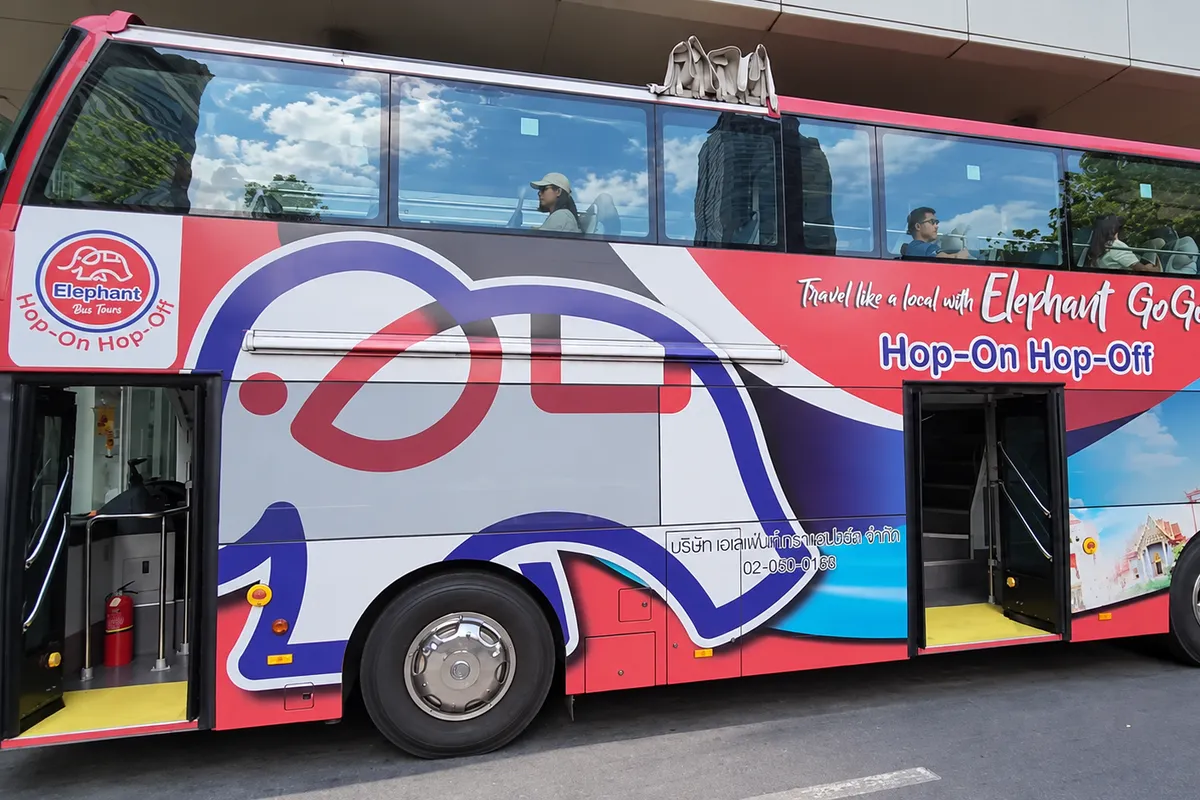
A full circuit takes about 2.5–3 hours before you get off anywhere, so the useful question in this Elephant Bus Tours Bangkok review is not how much you will see. It is whether an easy, traffic-bound overview is worth ฿800 when Bangkok’s trains and river boats cost far less.
My short answer: I would buy it for a relaxed first day, especially with children or travelers who do not want to decode several transport systems. I would skip it for a tight budget, a rushed temple itinerary or anyone expecting quick cross-city transport.
Overview and Boarding: How Elephant Bus Tours Works in Bangkok
Boarding Hub at Siam Paragon Gate 1 and Transit Access
The easiest place to start is Siam Paragon. The mall connects to BTS Siam through Exit 3, so you can reach the boarding area without crossing the road junction outside. Taxi and Grab pick-up and drop-off are at Gate 1 on the Ground Floor; the Siam Paragon access guide is useful if your driver needs the exact entrance.
The Elephant Bus Tours boarding point is outside LOCK BOX Plus+ on the Ground Floor at Gate 1, next to Bangkok Bank. That is a much more useful landmark than simply telling a driver “the sightseeing bus.” Arrive 15 minutes before departure, particularly if you still need to redeem your ticket.
You can also start at another stop by showing your confirmation to the driver. For a missing stop, an unclear pick-up point or a ticket problem, the operator’s customer-service and WhatsApp number is +66 64 181 1234. I would save it before leaving the hotel rather than searching for it on a hot pavement.
I would not bring a rental car to this tour. Central Bangkok congestion is already the route’s biggest weakness, and BTS, taxi or Grab makes the arrival much simpler.
Siam Paragon arrival checklist
- Take BTS Siam Exit 3, or ask for Ground Floor Gate 1.
- Find LOCK BOX Plus+ beside Bangkok Bank.
- Have your confirmation open and arrive 15 minutes before departure.
Pass Types, Validity Hours, and Elephant Bus Bangkok Tickets
Direct adult fares are ฿800 for 24 hours, ฿900 for 48 hours and ฿1,000 for 72 hours on the Elephant Bus Tours ticket page. Resellers can show promotional or packaged prices, so I would compare the final amount in baht and the cancellation terms. I would not choose travel dates around an assumed seasonal sale.
| Adult pass | Direct price | Best use |
|---|---|---|
| 24 hours | ฿800 | One orientation day or a short temple circuit |
| 48 hours | ฿900 | Two slower sightseeing days |
| 72 hours | ฿1,000 | Three days with plenty of stops and a loose schedule |
The clock starts when you redeem the pass, not when you buy it. These are consecutive hours, not calendar days: redeeming a 24-hour ticket in the afternoon gives you the same usable period the following day. An unused ticket remains valid for six months, which is handy if your plans move.
Children aged 6–12 pay 50% of the adult fare, and children aged five and under ride free. The extra ฿100 for 48 hours instead of 24 is reasonable; the 72-hour pass only makes sense to me if you will genuinely ride on all three days.
Bangkok Sightseeing Bus Routes: Temples and Cultural Landmarks
The 16-Stop Loop: Old Town Heritage and Historic Temples
Although it is easy to talk about Bangkok sightseeing bus routes in the plural, this product is built around one 16-stop loop. There is no second color line to learn. That simplicity is the main advantage: you can look at the Elephant Bus Tours route map, pick two or three stops and avoid turning the day into a transport puzzle.
- Siam Paragon
- MBK Center
- Samyan Mitrtown / Wat Hualumpong
- Wat Trai Mit
- China Town
- Grand China Hotel / Dragon Temple Kammalawat
- Loha Prasat / Pra tu phee
- Khao San Road
- Giant Swing
- Wat Pho
- Sanam Luang / Royal Grand Palace
Wat Pho is stop 10, while Sanam Luang and the Royal Grand Palace share stop 11. Do not treat the stop name as the attraction entrance: allow time for the walk, security and ticket lines, especially around the large open Sanam Luang area. On a hot day, that exposed walking can feel longer than the bus ride.
Attraction admission is not included. Wat Pho, the Grand Palace and every other paid sight along the loop charge separately. I would choose either Chinatown and the old-town stops or a deeper palace-and-temple visit, rather than hopping off everywhere and spending half the day waiting for another bus.
Riverside Crossings and Modern Hubs: Wat Arun to ICONSIAM
After the Grand Palace area, the route continues to Wat Arun at stop 12 and then through the more modern half of the loop. The remaining stops are ICONSIAM at 13, Mahanakhon Skywalk at 14, Patpong Night Market at 15 and CentralwOrld at 16, before the circuit returns toward Siam.
The important trap is the Wat Pho–Wat Arun transfer. They face each other across the Chao Phraya, but the bus cannot simply cross the river beside you. It follows the road network and bridges, so staying aboard can consume a large part of a congested afternoon just to reach a sight visible from the other bank.
If Wat Arun is your next target, I would use the short cross-river passenger boat from the Wat Pho side and rejoin the bus later. Pay for that boat separately. It sacrifices the bus’s sheltered seat, but it avoids a long road detour for what is geographically a very short crossing.
- Stay on the bus if you want the continuous narrated circuit and do not mind bridge traffic.
- Take the cross-river boat if Wat Arun is the only place you want on the opposite bank.
- Keep ICONSIAM or Mahanakhon as a separate stop, not a quick five-minute photo break.
Double Decker Bus Bangkok: Comfort, Accessibility, and Amenities
Upper Deck Open-Air Seating vs. Air-Conditioned Lower Cabin
The double decker bus Bangkok visitors usually picture has open-air seating upstairs and an indoor cabin below. Upstairs gives you the clearer view over traffic and riverside walls, which is the main reason to choose this tour over an ordinary taxi. The lower deck is the sensible retreat when the sun becomes tiring.
Open-air does not mean a constant pleasant breeze. In a jam, the bus can sit still in heat with traffic rumble and exhaust around it. At midday, I would rather have the lower-deck seat and a restricted view than bake upstairs just to prove I bought the right ticket.
Morning is my preference for the upper deck, with a hat, water and sunscreen. Stay seated on narrow old-town streets and keep cameras and arms inside the vehicle; low branches and roadside wires are not a photo opportunity. Standing up for one picture is a poor trade.
On the open deck, treat sun exposure and stopped traffic as part of the ride. Move downstairs if you feel overheated, and never lean out or stand to clear an obstacle for a photograph.
Multilingual Audio Guides and Stroller or Wheelchair Access
The pass includes an audio guide in English, Thai, Chinese, French, German, Korean and Spanish. You also receive a route map or guidebook, GPS bus tracking and discount coupons. The commentary is useful for identifying neighborhoods as they pass, although it cannot make a slow road move any faster.
For accessibility, the operator describes reserved wheelchair and stroller space with safety clamps. That is better than simply folding a stroller beside your seat, but the usable space is indoors rather than on the open upper deck. Anyone unable to manage bus stairs should plan around the lower cabin.
If step-free boarding is essential, contact the operator before paying and ask about the exact vehicle and boarding stop. A reserved area answers where a wheelchair goes; it does not by itself answer how you will board. I would get that arrangement clear in writing rather than improvise at a busy curb.
Managing Bangkok Traffic Delays and Bus Intervals
Navigating Peak Congestion and Realistic Loop Durations
The quoted 2.5–3 hours is for one full loop and depends on traffic. It is not the time required for a sightseeing day with stops. Add a palace visit, lunch and two transfers back to the bus, and the circuit becomes a framework for the day rather than a quick morning activity.
Chinatown, the old-town approach roads and bridge traffic are the places where I would leave the most slack. Traveler reports describe traffic-related service gaps and longer waits, but there is no dependable “standard” delay to plug into an itinerary. A posted interval should not be treated like a train connection.
I would also ignore any old promise of a bus every 35 or 45 minutes. Service frequency has been temporarily reduced, and road conditions can separate buses even when departures begin evenly. Avoid booking a tightly timed paid attraction immediately after a planned bus leg.
My practical approach is to make the first bus ride the overview, then choose no more than two major stops that genuinely interest me. Trying to beat the clock usually means more curb time and less sightseeing.
Tracking Buses in Real Time with the Live GPS System
The included GPS tracker is most useful when it stops you waiting outside for no reason. Check the live bus position before leaving a museum, café or shopping mall, and use the stop names from your route map so you and customer service are talking about the same place.
- Finish your visit with a little time in hand rather than rushing to the curb.
- Open the live tracker and look for a bus approaching your numbered stop.
- Stay somewhere shaded or air-conditioned until the bus is reasonably close.
- If the map looks stale or no bus is progressing, message +66 64 181 1234 on WhatsApp.
I would use the tracker as a decision aid, not a promise. A bus shown nearby can still take a while to clear the next junction. Conversely, if nothing is moving, that is your cue to switch to BTS, MRT or a boat instead of donating the afternoon to a bus stop.
Elephant Bus vs BTS, MRT, and River Ferries
Cost, Speed, and Convenience Comparison Across Transit Modes
For pure transport, the pass is not close to the cheapest option. BTS single fares are ฿17–฿62, while a BTS One-Day Pass costs ฿150 on the official BTS fare table. Orange-flag Chao Phraya Express Boat trips cost ฿16–฿19 according to the Chao Phraya Express Boat service. Three or four independent rides can come to roughly ฿100–฿180 in a day.
| Option | Cost logic | Traffic performance | What you gain |
|---|---|---|---|
| Elephant Bus 24-hour pass | ฿800 | Exposed to road jams | Open-deck views, audio guide and one simple loop |
| BTS and MRT | Pay per ride, or ฿150 for a BTS day pass | Avoids road congestion on covered sections | Faster cross-city links |
| Orange-flag river boat | ฿16–฿19 per trip | Avoids road bridges | Cheap access along the Chao Phraya |
That makes the bus roughly four to five times the cost of a basic independent day. I would not buy it for savings or speed. You are paying for an uncomplicated seat, commentary and the view, with traffic included whether you want it or not.
Smart Multimodal Sightseeing and When to Ditch the Bus
A hop-on hop-off pass does not require blind loyalty. Around Wat Pho, MRT Sanam Chai is useful when the roads are clogged. Between riverside sights, a boat can remove an entire bridge detour. At Siam, BTS is usually the cleanest way to leave the area once your bus day is done.
Get off at a designated stop and keep your pass confirmation available for a later ride. If you have an evening reservation across town, I would finish the bus segment earlier and switch modes rather than hope the traffic clears. The same traffic-first thinking applies in my Big Bus Rome route and value review.
Temple transfers also need a little preparation. Wear or carry clothing that covers shoulders and knees, and bring small baht notes for admissions and local boats. None of that is included in the sightseeing pass.
For a mixed bus, train and boat day, I would pack water, sunscreen, a light temple-cover layer, small cash and a power bank. The power bank matters: GPS tracking, tickets and WhatsApp all become less useful when your phone is flat.
Elephant Bus Tours Bangkok Review: Value and Booking Guide
Direct Operator Purchase vs. Online Travel Agencies
Buying direct gives you a simple price benchmark: ฿800, ฿900 or ฿1,000, with six months to use the unactivated ticket. Traveloka, Klook and Viator can offer different totals or booking conditions. I would choose based on the final baht price and cancellation flexibility, not because one checkout screen looks more familiar.
| Buying channel | Main reason to use it | Condition to read |
|---|---|---|
| Direct from Elephant Bus Tours | Clear standard fares and six-month ticket validity | The cancellation condition attached to your purchase |
| Viator | Its listed cancellation policy may suit changeable plans | Full refund requires cancellation at least 24 hours before the experience |
| Other online agencies | Occasional promotional prices or packages | Final fare, pass duration and redemption instructions |
Viator’s 24-hour refund condition belongs to that reseller booking; it is not a blanket rule for every Elephant Bus ticket. Likewise, six months of ticket validity is not the same thing as a six-month refund window. Those are separate details, and confusing them can be expensive.
After buying, redeem at the Siam Paragon counter or show the confirmation to the driver at a stop. Keep the confirmation offline as well, so a weak mobile signal does not hold up boarding.
What to check before you go
- Confirm the operating hours and first and last departures for your travel date.
- Check the day’s timetable and live bus locations before planning around a particular wait.
- Review the final price at checkout rather than relying on an old promotional figure.
- Ask about the vehicle and boarding arrangement if wheelchair or stroller access is essential.
- Read the cancellation terms for the exact seller you use.
Who Should Buy the Pass–and Who Should Skip It
The strongest reasons to buy are the easy 16-stop layout, open-air views, seven-language audio guide and freedom from planning every transfer. Free rides for children five and under also soften the family cost. For travelers who find large stations confusing, one recognizable bus can remove a lot of friction.
- Buy the 24-hour pass for a relaxed first-day overview with one or two major stops.
- Choose 48 hours if you genuinely want two slower sightseeing days; the extra ฿100 is modest.
- Consider 72 hours only when your itinerary gives you three useful riding days.
The drawbacks are just as clear: ฿800 is expensive beside public transport, temple admissions cost extra, and no ticket removes Bangkok’s jams. A delayed bus can undermine a carefully sequenced itinerary, while the open upper deck is uncomfortable when heat and exhaust build up.
I would tell budget backpackers, rushed visitors and confident BTS-and-boat users to skip it. My own choice would be the 24-hour pass for orientation, followed by independent transport once I knew where I wanted to go. If easy logistics matter more than price, it earns its fare; if you mainly need to reach Wat Pho, the Grand Palace and Wat Arun efficiently, it does not.