

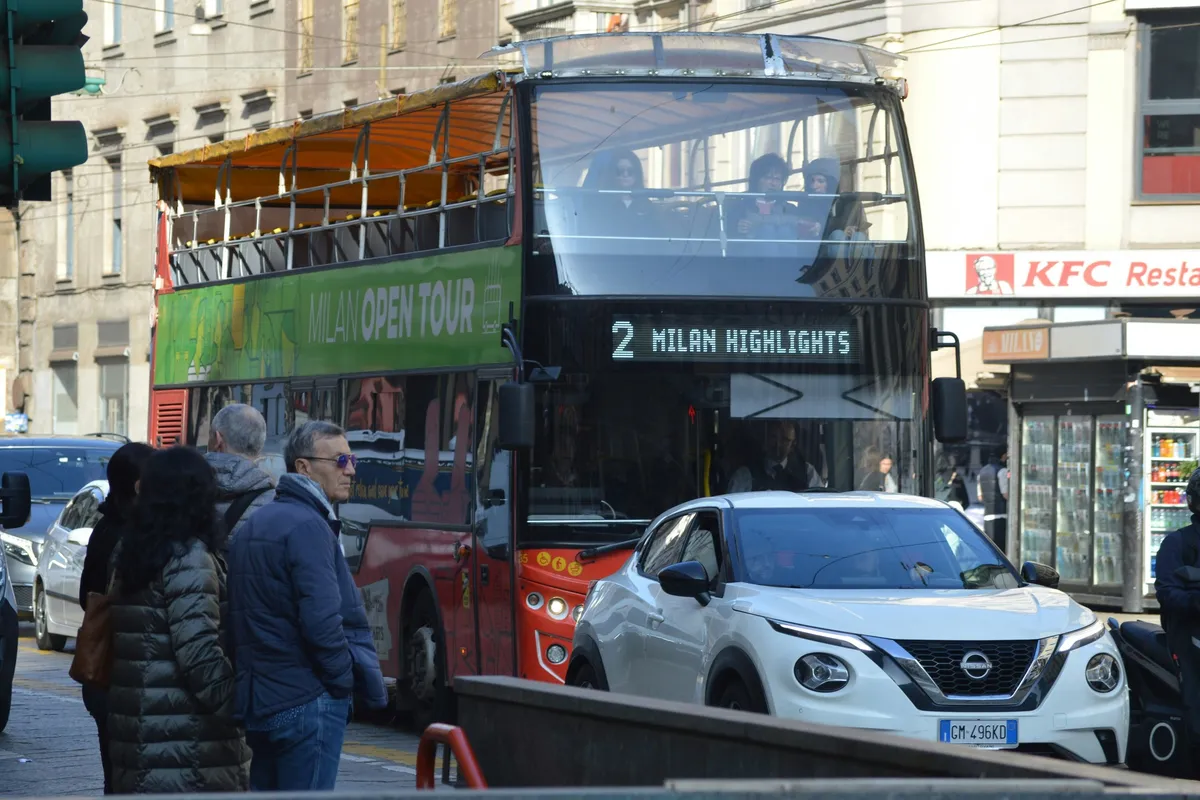
Milan's sights spread from the Gothic spires of the Duomo to the concrete arches of San Siro and the glass towers of Porta Nuova, and four City Sightseeing lines loop the city on separate circuits that meet at a handful of shared stops. Where you board decides which half of the city you see first: the main terminal is at Foro Buonaparte 10, beside Castello Sforzesco, with Piazza del Duomo 17 and the stop outside Stazione Centrale handling most of the rest.
The operator lists four lines, more than 40 stops and a fleet of seven open-top double-deckers, with recorded commentary in ten languages. Entry fares start at €25 on the operator's own site, while resale platforms such as GetYourGuide and Viator often advertise the same 24-hour ticket from €22.50, so the price you pay depends partly on where you book.
Where to Board in Milan: Terminals, Hubs and Metro Access
Finding your bus in central Milan is straightforward if you stick to the main transit interchanges. The primary boarding terminal sits at Foro Buonaparte 10, right outside Castello Sforzesco. You can reach this stop on foot in two minutes from Cairoli station on the M1 red subway line, or via a five-minute walk from Cadorna FN, which serves both the M1 and M2 lines alongside regional Malpensa Express trains. Staffed help sits at the operator's visitor centre around the corner at Via Cusani 18.
The second major hub is Piazza del Duomo 17, situated steps from the cathedral facade and served directly underground by Duomo station on the M1 and M3 lines. For rail travelers arriving from other Italian cities, a dedicated stop operates right outside Stazione Centrale at Piazza Duca d'Aosta (Galleria delle Carrozze), connecting directly to the Centrale FS subway hub on lines M2 and M3.
Do not attempt to drive a rental car or personal vehicle to any of these pickup points. Central Milan operates under the strict Area C congestion charge zone, which bills entering vehicles and restricts traffic, while curbside parking near the cathedral and castle is virtually non-existent. Stick to the metro to reach the departure hubs. The local office lists +39 02 867131 and infomilano@city-sightseeing.it for scheduling questions.
The fleet, the audio system and what to bring
The Milan operation runs seven open-top double-deckers inside the national City Sightseeing Italy network, which the operator describes as four lines, more than 40 stops and commentary in ten languages. On 15 January 2026 the whole City Sightseeing Italia group passed into the full ownership of Busitalia, the FS Group's road-transport arm. The lower deck provides closed, climate-controlled seating with large side windows, while the upper deck gives you panoramic views over Milan's streetscapes, historic facades, and overhead tram cables.
Each seat has an audio panel with a standard 3.5 mm headphone jack, and a pair of disposable wired earphones is handed over when your ticket is scanned at the door. Those free buds are thin. On a packed Line B run the traffic roar drowned most of the commentary, so I now carry my own 3.5 mm earbuds; they shut out the engine noise and stay comfortable through a two-hour ride.
The automated guide runs in ten languages: Italian, English, French, German, Spanish, Portuguese, Russian, Japanese, Arabic, and Chinese. A separate child-friendly track uses short stories and curiosities. The same hardware appears on the City Sightseeing Florence buses, so a set of earphones bought for one Italian city works on the other.
Lines A, B, C and D: Stops, Loop Times and Headways
The four lines divide the city into historic, commercial, sporting and residential circuits, and each one runs its own loop. Loop lengths and headways differ sharply, so the line you pick decides how much of the day the bus itself consumes. The full stop-by-stop route map and the current timetable PDF are published on the City Sightseeing Milan page, and City Sightseeing's published schedule for the current season lists the four lines as follows.
| Line | Focus | Full loop | Headway | First and last departure |
|---|---|---|---|---|
| A (red) | Historic centre | about 50 min | every 50 min | 11:40 from Castello, 12:08 from Duomo; last 18:40 |
| B (blue) | Modern city and shopping | about 55 min | every 20–30 min | 09:30 from Centrale, 10:00 from Duomo; last 17:40 / 18:10 |
| C (green) | Sport and CityLife | 80–90 min | about every 90 min | 10:15; last 17:45 |
| D (yellow) | Navigli and Brera | about 75 min | every 30 min | 09:30 from Duomo, 09:50 from Castello; last 18:55 / 18:15 |
Each line's published stop sequence runs as follows:
- Line A (8 stops): Castello (Foro Buonaparte 10), Cadorna, Cenacolo (Via Caradosso 6), Corso Magenta, Duomo (Piazza del Duomo 38), Monte Napoleone (Via Manzoni 16), Manin (Via Manin 21a), Moscova (Via della Moscova 68).
- Line B (9 stops): Duomo (Piazza del Duomo 38), Monte Napoleone, Manin, Repubblica (Piazza della Repubblica 28), Palazzo Lombardia, Stazione Centrale, Buenos Aires (Corso Buenos Aires 7), Porta Venezia, San Babila (Via Larga 2).
- Line C (15 stops): Castello, Triennale, Arco della Pace, CityLife (Piazza Sei Febbraio), Casa Milan (Via Aldo Rossi 8), MiCo (Via Guglielmo Silva 20), Lotto, Lido, Ippodromo, San Siro (Gate 8), Lotto (Via Monte Rosa 93), Buonarroti, Pagano, Conciliazione, Sempione.
- Line D (10 stops): Castello, Cadorna, Cenacolo, Navigli (Via Vigevano), Piazza XXIV Maggio, Via Olona (Via Ariberto 31), Corso Magenta, Duomo, Monte Napoleone, Brera (Via Fatebenefratelli 5).
Matchday suspension on Line C: the operator's route notes list stops 8, 9 and 10 (Lido, Ippodromo and San Siro) as suspended during football matches and major events, when police close the roads around the stadium. Build the sports loop into a non-match morning.
Where the four lines meet
You do not need to buy separate tickets to switch lines. The entire four-route layout is built around easy interchanges where buses pause briefly to swap passengers. The most critical interchange is Foro Buonaparte 10 at Sforza Castle, where Lines A, B, C, and D converge. If you want to sample modern architecture after touring medieval brick ramparts, you simply step off Line A and wait at the same bay for Line B or Line C.
Piazza del Duomo 17 serves as the second major transfer junction, connecting Line A and Line B. It drops you right in front of the marble cathedral and the entrance to Galleria Vittorio Emanuele II. For museum stops, Line D drops art lovers near Pinacoteca di Brera along Via Fatebenefratelli, while Line A stops at Manzoni - Scala for the opera museum.
The Cenacolo stop sits close to Santa Maria delle Grazie, but a bus pass does not include entry to Leonardo da Vinci's The Last Supper. That visit needs a museum reservation booked well ahead, so arriving with a bus voucher will not get you past the door. Curb marker poles on the official route map are the reliable way to confirm which stop you are standing at.
Ticket Options: Passes, Prices and Booking Rules
City Sightseeing structures its ticketing around four durations, with basic adult fares starting from €25 on the City Sightseeing Milano booking page. Resale platforms often list the shorter passes a little below that, so compare before you commit.
| Pass | Typical adult fare | Validity window | Best practical use case |
|---|---|---|---|
| 1-Day Pass | €25 | Calendar day of first scan until the last evening run | A full day of looping with a morning start |
| 24-Hour Pass | €22.50–28 | 24 rolling hours from first validation | Afternoon arrivals exploring over two half-days |
| 48-Hour Pass | €28–32 | 48 rolling hours from first validation | Weekend stays covering San Siro, Navigli and the centre |
| 72-Hour Pass | €32–36 | 72 rolling hours from first validation | Relaxed multi-day visits using the bus for daily orientation |
The lower figures come from resale platforms and the higher ones from the operator's own site. The gap between the first two rows is the one that catches people out.
There is a real operational trap between the 1-Day and 24-Hour passes. A 1-Day pass expires the second the final bus pulls into the garage on the day you activate it. A late arrival once cost me a full day of riding: I validated a 1-Day pass at 15:30 at Piazza del Duomo, and it expired with the last departure; the 24-hour pass would have kept running until 15:30 the next day. The mechanics are set out in calendar day versus rolling 24-hour tickets.
All standard tickets include unlimited boarding across Lines A, B, C, and D, multilingual audio access, disposable earphones, and connection to the Sightseeing Experience app. Museum admissions, cathedral roof terrace tickets, and ATM municipal metro rides are strictly excluded. The service does not operate on 25 December.
Travelers whose dates are not fixed can buy an Open Ticket for City Sightseeing Italy for €25; the digital voucher stays valid for 12 months from purchase across participating Italian branches, and scanning it on board starts a standard 1-day window. Dated tickets bought online can be cancelled for a full refund up to 24 hours before the selected date, while promotional bundles and packages that include museum admissions are non-refundable. Mobile vouchers work straight from a phone screen, and the operator's flexible option lets you use a booked voucher within five days of the chosen date.
Bundles: night tour, Milan Pass and the Last Supper combo
Several packages combine the bus with landmark admissions:
- Milan Night Tour by Open Bus (from €19): a seasonal evening circuit of illuminated monuments, departing from Largo Cairoli at 19:30 and 20:45. It runs one non-stop loop, so you cannot get off mid-route and board a later bus.
- The Milan Pass (from €99): multi-day hop-on hop-off access alongside admissions to the Duomo terraces, the Leonardo3 Museum, and several municipal cultural spaces.
- Milan Half-Day Tour with Da Vinci's Last Supper (from €119): open-top bus travel with a guaranteed, pre-booked guided entrance to view The Last Supper inside Santa Maria delle Grazie.
If the single goal is seeing The Last Supper without spending weeks hunting individual ticket drops, the €119 bundle is a workable shortcut. Otherwise, a standard bus pass plus museum tickets booked separately on official state sites costs less. One more variant worth knowing: the 72-hour weekend pass sold for Saturdays and Sundays between June and September includes the Night Tour at no extra charge.
On Board: Traffic, Weather, Luggage and Access
Traffic is the part of a Milan bus day that no timetable controls. The worst delays strike central arteries like Via Manzoni, the tight corners encircling Piazza Cordusio, and the approach boulevards around Stazione Centrale during weekday morning rush (08:30–10:00) and evening peak hours (17:30–19:30).
During those hours a scheduled 20-minute gap between buses can stretch past 40 minutes as vehicles crawl behind local delivery vans and historic street trams. On sunny weekend mornings the top-deck queue builds quickly at Piazza del Duomo and Castello. Once the upper deck fills, drivers restrict boarding at mid-route stops, leaving passengers on the pavement waiting for the next bus.
The open upper deck gives the best vantage points for rooftop carvings and palazzo balconies, but there is no shade canopy while the bus is moving. Milan summers are humid and scorching, so a brimmed hat, sunscreen and water are not optional. On a humid July afternoon I took a front seat on Line D out of Castello, and by the Navigli my forearms were pink and my water bottle was empty; I now ride upstairs early or late and stay below at midday. In winter and late autumn, wind on the exposed deck makes a light jacket feel inadequate within a few stops.
The free Sightseeing Experience app shows live GPS positions for buses on all four lines, your nearest boarding pole, and self-guided walking loops through the centre. Downloading it before you leave the hotel beats standing at a curb guessing when the next bus will appear.
The entire Milan fleet features low-floor curbside entry and a manual or motorized ramp to accommodate wheelchair users. Each double-decker carries one dedicated wheelchair bay secured with restraint harnesses on the lower deck. Because capacity is limited to one wheelchair per bus, access is granted on a first-come, first-served basis.
Luggage space inside the vehicle is tight. Small daypacks, totes, and compact cabin bags that fit securely on your lap or between your feet are fine; the operator bars bulky suitcases, big backpacks and awkward bags outright, because the buses have no luggage hold and blocked aisles are a safety hazard. Milan Open Tour allows a single piece measuring up to 50x30x25 cm, which shows how small the allowance is on both networks.
Small and medium-sized dogs are allowed on board, provided they are kept on a short leash and wear a muzzle, or are transported inside an enclosed pet carrier. Assistance and guide dogs ride free without restrictions across all four lines.
City Sightseeing vs Milan Open Tour, and vs the ATM Metro
Milan has a second open-top operator, and its routes overlap with City Sightseeing without matching them.
| City Sightseeing Milano | Milan Open Tour | |
|---|---|---|
| Lines | 4: A (red), B (blue), C (green), D (yellow) | 3: Fashion, Design & Leisure; Milan Highlights; Sporting |
| 24-hour adult fare | from €22.50 (resale) to €28 (operator) | €25 |
| 48-hour adult fare | €28–32 | €30 |
| 72-hour adult fare | €32–36 | €35 |
| Child fare | free from 0 to 4 | €10 for ages 5 to 15 |
| Commentary | 10 languages | 11 languages, plus a child track in three |
| Extras | live-tracking app, Wi-Fi on board | Wi-Fi, USB sockets, drinks and snacks, walking-tour app |
Milan Open Tour charges €25 for 24 hours, €30 for 48 and €35 for 72, which undercuts City Sightseeing on the longer passes; only resale City Sightseeing tickets at the 24-hour mark come in below that. Milan Open Tour runs three routes to City Sightseeing's four, so it reaches less of the city. It publishes its own fares and route map on Milan Open Tour.
Milan's municipal public transit network (ATM) is among the most efficient in Europe. Before spending €22.50 to €28 on an open-top bus, take a hard look at the price difference compared to municipal public transit options.
| Transit Option | Adult Cost | Network Reach | Traffic Vulnerability |
|---|---|---|---|
| ATM Single Ticket | €2.20 | 90 mins valid on Metro, Bus, Tram (Mi1–Mi3) | Metro: Zero / Trams: Moderate |
| ATM 24-Hour Pass | €7.60 | 24 hrs unlimited across entire urban network | Metro: Zero / Trams: Moderate |
| ATM 3-Day Pass | €15.50 | 72 hrs unlimited across entire urban network | Metro: Zero / Trams: Moderate |
| City Sightseeing Milan | €22.50–28 (1-Day / 24h) | 4 tourist lines / ~40 sightseeing stops | High (shares road with street traffic) |
An ATM 24-hour transit pass costs just €7.60, and tapping a contactless credit card at subway gates automatically caps your daily fare at €7.60 after your fourth ride. The current figures are listed on ATM's Milan ticket page. If the only goal is getting from Stazione Centrale to the Duomo and onward to San Siro as quickly as possible, the subway beats the open-top bus every time: it runs every 2 to 4 minutes underground and completely bypasses traffic jams.
Subways, though, run in pitch-black tunnels with nothing to look at. The City Sightseeing ticket is an orientation and entertainment purchase, buying elevated views, curated audio history, and freedom from underground line transfers, and that is the case weighed against a metro fare in bus versus metro and city bus costs. A standard €2.20 ATM ticket also covers a ride on Milan's historic tram network, though without recorded commentary.
First-time visitors spending 24 to 48 hours get the most from the bus, as do families with young children, who use the dedicated child audio channel and avoid the steep subway steps, and travelers with limited mobility, who prefer sightseeing from a comfortable seated perch. Solo budget backpackers who can navigate ATM for €7.60 a day, business travelers on strict schedules, and anyone holding a timed museum booking should think twice.
Verdict: When the Milan Bus Is Worth It
The Milan open-top tour earns its price by linking sights that sit far apart, such as Casa Milan, San Siro and the Navigli, without repeated changes underground. Having four intersecting lines on a single ticket offers solid network coverage compared to other European operators that limit buyers to two lines, and the interchange at Castello means you rarely wait at an unfamiliar stop.
Against that, the network is slow where it matters most. Milan's central core is compact and dense, so the bus spends long stretches in the same few blocks, and the last departures leave before the city's restaurants open for dinner, which rules the bus out as an evening ride home from the Navigli.
Two purchases I would skip. The €119 Last Supper bundle only makes sense if a reservation through the museum's own ticket office is genuinely impossible, since the entrance itself is a fraction of that price; and a 1-Day pass activated after lunch is the worst value on the menu, because it dies with the evening's final bus.
Ownership changed in 2026. Since Busitalia took full control of City Sightseeing Italia on 15 January, the group has been folded into the FS Group's intermodal plan, and the most visible consequence for riders is at the till: Trenitalia now sells City Sightseeing vouchers, and buying the voucher together with a train ticket to Milan takes 20% off the bus price on Trenitalia's City Sightseeing page.
Before you travel: online vouchers can be used on any date within five days of the one you select, which softens a flight change. On high-season weekends the bus can fill at the first stop, so start at Castello or Stazione Centrale, where the bus begins empty, and keep the Sightseeing Experience app open to see where the next bus actually is.