

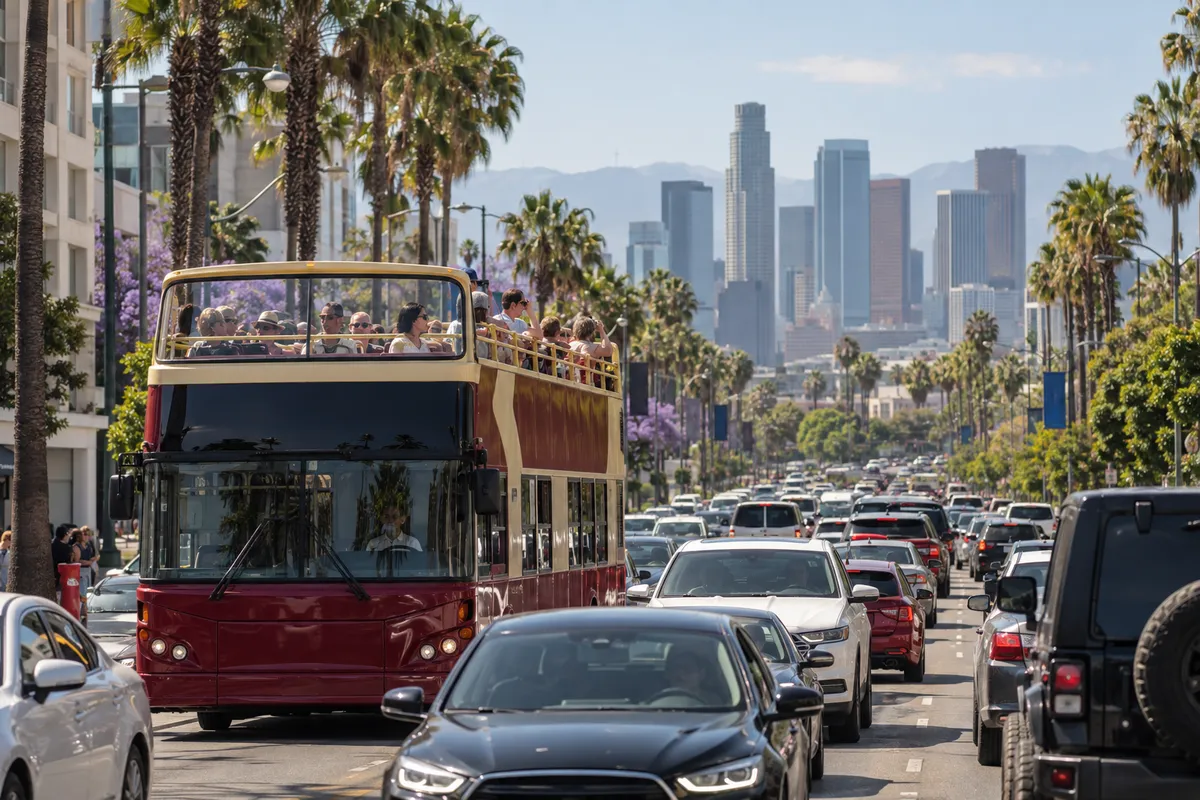
Sitting on the upper deck of an open-top sightseeing bus along Hollywood Boulevard, the Southern California sunshine feels ideal until the vehicle hits the bumper-to-bumper crawl of midday traffic. Navigating Los Angeles requires understanding that distances on a map are deceptive; a 14-mile journey can effortlessly consume two hours when choked by arterial intersections. When evaluating la hop on bus vs uber, the deciding factors are rarely marketing promises of open-air relaxation, but rather how each transport mode tackles severe congestion, inflexible operational schedules, and escalating per-trip expenses.
During my field evaluations of open-top sightseeing buses across North America and Europe, Southern California proved to be the most logistically unforgiving environment. Exploring the region requires balancing the scenic advantages of sightseeing fleets against the rapid point-to-point agility of rideshares and the traffic-free predictability of regional rail. Choosing the wrong transit method between Hollywood, Downtown, and the coast will turn your sightseeing itinerary into an exhausting lesson in urban gridlock.
LA Hop-On Bus vs Uber: Surface Street Reality and Scheduling Traps
Surface Street Congestion: Why Tour Buses Miss Freeway Speed
The operational divide between commercial sightseeing operators and dynamic rideshares comes down to road geometry. Commercial carriers such as Big Bus Los Angeles and Starline Tours City Sightseeing operate heavy double-decker coaches that are physically confined to pre-determined boulevard routings. These vehicles crawl along thoroughfares including the Sunset Strip, Santa Monica Boulevard through West Hollywood, and the Wilshire Boulevard transit corridor, exposing passengers directly to local traffic signals and dense bottlenecks.
While an UberX driver relies on real-time navigation algorithms to detour through side streets or divert onto multi-lane freeways, open-top tour buses cannot deviate from their published stops. A bus stuck behind delivery vehicles near the Laugh Factory or Chateau Marmont has no alternative escape route. Consequently, surface street traffic gridlock routinely stretches peak one-way travel times between Hollywood and the ocean to between 90 and 120 minutes during afternoon hours.
Sitting on an idling top deck in midday heat while inhaling diesel fumes from surrounding traffic quickly diminishes the romance of open-air sightseeing. For travelers attempting to move efficiently between distant neighborhoods, hop-on hop-off buses function primarily as slow-moving panoramic viewing platforms rather than functional transit vehicles. In heavy traffic, rideshares consistently outperform sightseeing buses in travel duration by utilizing parallel highway infrastructure.
If your goal is reaching the coast for an afternoon booking, avoid boarding an open-top bus after 1:00 PM. Boulevard congestion intensifies sharply after lunch, often doubling transit times along Santa Monica and Wilshire Boulevards.
Daily Frequency Caps and Early Cutoffs: The Transfer Bottleneck
Tour bus timetables introduce severe scheduling bottlenecks that surprise many first-time visitors. The Big Bus Hollywood Loop (Red Route) features 12 stops operating from 10:00 AM to 4:30 PM with departures spaced 30 to 45 minutes apart, taking approximately 2 hours for a single complete circuit. While this frequency provides reasonable flexibility for exploring central Hollywood, connecting to the coast introduces severe scheduling constraints.
The Big Bus Beach Loop (Blue Route) operates only 5 to 6 departures per day. Passengers transferring between the loops must do so at the Beverly Gardens Park transfer point. The most critical operational vulnerability is the timetable cutoff: the final Beach Loop bus departs Santa Monica Pier back toward Beverly Hills at 3:45 PM. Travelers who lose track of time at the beach face an abrupt end to their tour bus service.
Missing that 3:45 PM departure leaves you stranded on the Westside without tour transportation back to Hollywood or Downtown LA. At that hour, evening commuter congestion is peaking, forcing stranded tourists to hail an UberX under rideshare surge pricing. That unplanned return trip routinely costs between $55 and $85+, completely wiping out any theoretical savings from an open-top bus pass.
The 3:45 PM final departure from Santa Monica Pier is strictly enforced. If you miss this shuttle, your tour bus ticket cannot get you back to Beverly Hills or Hollywood, requiring an expensive rideshare ride during peak commuter traffic.
Los Angeles Tour Bus vs Metro: Head-to-Head Transit Times Across Core Corridors
Hollywood Walk of Fame to Santa Monica Pier: Rail Bypasses vs Boulevard Crawl
Evaluating los angeles tour bus vs metro reveals dramatic disparities along the signature tourist route connecting Hollywood to the Pacific Ocean. Travelling between the Hollywood Walk of Fame and Santa Monica Pier via public transit requires boarding the subterranean Metro B Line Red Subway at Hollywood/Highland, travelling to 7th St/Metro Center, and making an underground transfer to the light rail Metro E Line Expo. According to official schedules on LA Metro, this rail journey takes between 68 and 78 minutes flat for a total cost of $1.75.
By comparison, riding an open-top tour bus along the same corridor requires taking the Hollywood Loop to Beverly Gardens Park, waiting for the infrequent Beach Loop, and crawling through Westside surface traffic. During off-peak morning hours, this journey consumes roughly 90 minutes; during afternoon peak traffic, the run time routinely stretches beyond 120 minutes. Taking an UberX over the 14-mile route takes 25 to 35 minutes off-peak for $28 to $38, but surges to 60 to 95 minutes and $55 to $85+ during the 3:30 PM to 7:00 PM weekday commuter window.
| Mode | Off-Peak Duration | Peak Rush Duration (3:30–7:00 PM) | Cost per Passenger | Reliability Rating |
|---|---|---|---|---|
| Hop-On Hop-Off Bus (Big Bus) | 90 minutes (via transfer) | 90 to 120+ minutes | $59.00 (24h pass) | Low (transfer caps) |
| LA Metro Rail (B Line to E Line) | 68 to 78 minutes | 68 to 78 minutes | $1.75 (free 2h transfer) | High (traffic-free rail) |
| UberX Rideshare | 25 to 35 minutes | 60 to 95 minutes | $28–$38 off-peak / $55–$85+ peak | Moderate (freeway delays) |
Navigating the transfer at 7th St/Metro Center is straightforward. Riders arrive at the lower subway platform on the B Line, take the escalators up one level to the light rail concourse, and board the westbound E Line train toward Downtown Santa Monica. Because LA Metro includes unlimited free transfers between lines for up to 2 hours after your initial tap, the entire cross-county trek costs just $1.75.
Downtown LA to the Coast: Metro E Line Expo Reliability vs Interstate 10
The transit corridor between Downtown Los Angeles and the coast illustrates the stark contrast between fixed guideway rail and highway gridlock. The Metro Rail E Line connects 7th St/Metro Center directly to Downtown Santa Monica Station in exactly 46 minutes on a fixed schedule. Because the tracks run along a dedicated right-of-way that bypasses Interstate 10 Santa Monica Freeway congestion, travel duration remains constant regardless of the day or weather.
In contrast, motor vehicle travel along Interstate 10 is notoriously unpredictable. An UberX ride covering the roughly 15 miles between Downtown LA and Santa Monica takes an easy 22 to 30 minutes in clear traffic, costing $30 to $42. However, during evening rush hours, that exact drive extends to between 55 and 85 minutes, with surge fares escalating to $50 to $80+.
The E Line also provides convenient access to intermediate neighborhoods, including the elevated Culver City Station for midday dining and gallery visits, before continuing out to the beach. For travelers visiting coastal sights without needing sightseeing narration, spending $1.75 on the train provides guaranteed arrival times that no highway vehicle can match.
On Friday afternoons, Interstate 10 westbound jams can begin as early as 1:30 PM. The Metro E Line eliminates traffic stress entirely, pulling into Downtown Santa Monica just three blocks from the pier in 46 minutes.
Subterranean Speed: Hollywood/Highland to Union Station
For cross-town travel between central Hollywood and the historic core of Downtown Los Angeles, the heavy-rail Metro B Line Red Subway outpaces all road transport. Running deep underground entirely separate from street traffic, the B Line connects Hollywood/Highland to Union Station in 20 minutes flat for the standard $1.75 base fare. It operates unaffected by accidents or construction along the parallel US-101 Hollywood Freeway.
Driving that same route on the US-101 or along Sunset Boulevard requires 30 to 60 minutes of stop-and-go driving during typical daytime hours. While an open-top bus lets you look up at historic theater marquees, relying on it to travel between these districts wastes valuable sightseeing hours. Starline Tours City Sightseeing operates multi-lingual commentary in 9 languages across its routes, which aids orientation, but it cannot speed up dense surface bottlenecks.
Arriving at Union Station by subway places you at Southern California's primary transit hub. From the train platforms, passengers can easily walk over to the regional Metrolink commuter rail trains or head to Patsaouras Transit Plaza on the eastern side of the complex. There, travelers can board the non-stop LAX FlyAway bus directly to the airport for a flat fare of $9.75.
Rideshare Economics: Surge Pricing, Airport Pickups, and Gridlock Exposure
Estimating Real Uber Costs: Off-Peak Bargains vs Peak Rush Surcharges
Evaluating rideshare expenses requires looking beyond base fare estimates to understand how dynamic surge pricing affects daily travel costs. During off-peak midday hours, an UberX between Hollywood and Santa Monica costs $28 to $38, while trips between Downtown LA and Santa Monica average $30 to $42. For travelers moving at a relaxed pace outside rush hours, rideshares offer rapid door-to-door transit without the rigid route limits of a tour bus.
The financial dynamic changes dramatically during the weekday commuter window from 3:30 PM to 7:00 PM. High demand triggers rideshare surge pricing across the Westside, pushing fares between Hollywood and Santa Monica to $55 to $85+, and Downtown trips to $50 to $80+. Because rideshare meters bill for both elapsed time and distance, idling in highway bottlenecks continuously drives up the total fare.
Party size fundamentally alters the cost calculation against commercial tour operators. A single adult 24-hour Discover ticket for Big Bus Los Angeles costs $59.00 at gate pricing, while a child ticket (ages 3–12) costs $49.00. For a party of three or four adults, sightseeing passes would total $177.00 to $236.00 for a single day. Splitting a $28 to $38 off-peak UberX between four travelers equals just $7 to $10 per person per trip, offering significant savings compared to multi-ticket tour bus passes.
| Route Corridor | Off-Peak UberX (Midday) | Peak UberX (3:30–7:00 PM) | Big Bus Discover Ticket (1 Adult) | UberX Cost per Person (4 Riders, Off-Peak) |
|---|---|---|---|---|
| Hollywood to Santa Monica Pier | $28.00–$38.00 | $55.00–$85.00+ | $59.00 | $7.00–$9.50 |
| Downtown LA to Santa Monica Pier | $30.00–$42.00 | $50.00–$80.00+ | $59.00 | $7.50–$10.50 |
| Hollywood to Downtown LA | $22.00–$30.00 | $40.00–$65.00+ | $59.00 | $5.50–$7.50 |
Arrival Logistics: Navigating the LAX-it Lot Without Wasting Hours
Arriving at Los Angeles International Airport (LAX) involves a specific rideshare pickup process that can easily consume 45 minutes if planned incorrectly. Airport authorities prohibit standard UberX, Lyft, and taxi pickups at terminal curbsides. All arriving passengers using rideshares must travel to the dedicated 'LAX-it' lot located just east of Terminal 1, as outlined on the official LAX-it pickup guide.
Travelers landing at Terminals 1, 2, or 7 can reach the LAX-it lot quickly via marked pedestrian pathways in 3 to 8 minutes on foot. However, passengers arriving at outer terminals–including Terminals 4, 5, and the Tom Bradley International Terminal–will find walking with heavy luggage cumbersome. These terminals require boarding the complimentary green LAX-it shuttle buses that circulate through the terminal horseshoe.
During peak evening arrival windows between 7:00 PM and 11:00 PM, shuttle boarding queues can take 15 to 30 minutes, followed by an additional wait in the lot queue for your driver to arrive. Travelers heading directly Downtown can bypass the LAX-it lot entirely by boarding the scheduled FlyAway bus directly from the terminal curbside for $9.75, which drops passengers off at Patsaouras Transit Plaza at Union Station.
If you land at Terminal 1, 2, or 7 with carry-on luggage, skip the shuttle queue. Walking directly across the sidewalk to the LAX-it lot saves up to 20 minutes during evening arrival banks.
Getting Around LA: Tourist Bus vs Driving and Rental Car Realities
Parking Economics: Garage Maximums at Major Sightseeing Hubs
When weighing getting around la tourist bus vs driving, visitors often overlook the substantial cost of parking at major attractions. Finding street parking near signature landmarks is difficult, leaving commercial garages as the only realistic choice. These daily parking fees quickly offset any savings gained from renting an economy vehicle.
At the center of Hollywood, parking at the Ovation Hollywood parking structure costs $2.50 every 20 minutes ($7.50 per hour) up to a daily maximum rate of $25.00. Visitors can reduce this to $3.00 for up to 2 hours by obtaining validation from participating shops and restaurants, or up to 4 hours for $3.00 with validation from select entertainment venues. Without validation, spending half a day sightseeing in Hollywood costs the full $25.00 maximum.
Parking along the coast carries similar expenses. City of Santa Monica public beach lots and downtown parking structures charge between $15.00 and $25.00 per day depending on the season and day of the week. Beverly Hills provides some relief with city-operated public garages, such as 450 N. Rexford Drive and 9510 Brighton Way, which offer the first 2 hours free. Even so, when you factor in California retail gasoline averaging over $4.50 to $5.00 per gallon and overnight hotel valet fees running $40.00 to $75.00 per night, rental car expenses add up quickly.
- Ovation Hollywood Garage: $2.50 per 20 minutes; $25.00 daily maximum ($3.00 for 2 hours with validation).
- Santa Monica Beach & Downtown Lots: $15.00 to $25.00 flat daily rate based on season.
- Beverly Hills Municipal Garages: First 2 hours free; standard hourly rates apply thereafter.
- Vehicle Operating Overheads: Gasoline running above $4.50–$5.00 per gallon plus hotel parking.
Freeway Traps: HOV Lane Violations and Metro ExpressLanes Tolls
Driving on Los Angeles freeways requires understanding specialized lane restrictions that carry heavy fines. Visitors hoping to bypass rush-hour bottlenecks by using High-Occupancy Vehicle (HOV) lanes must have at least two (or in some zones three) occupants in the car. Solo drivers illegally using HOV carpool lanes face a minimum total fine of $490 under California Vehicle Code Section 21655.5 after mandatory state and county penalty assessments are added to the $100 base fine.
A more common pitfall for out-of-state drivers occurs on the Interstate 10 and Interstate 110 freeways, which feature Metro ExpressLanes. Unlike standard carpool lanes, these express lanes require every vehicle to have an active FasTrak transponder mounted on the windshield, even when carrying multiple passengers. Entering an ExpressLane without a transponder triggers automated overhead cameras.
Driving through the ExpressLanes without a transponder incurs the variable toll plus an $8.00 toll violation processing fee per occurrence. If left unpaid, this penalty escalates with additional late fees up to $55.00 per violation. Rental car agencies also add their own third-party electronic toll administration fees–often $3.95 to $5.95 per day–turning an accidental highway merge into a costly rental car invoice surcharge.
Never enter the I-10 or I-110 Metro ExpressLanes without a functioning FasTrak switchable transponder set to the correct passenger count. Carpool status alone does not exempt vehicles from the transponder requirement.
Metro Value Breakdown: Fares, TAP Card Fare Capping, and Station Navigation
Open-Loop Tap Payments and Daily Fare Capping Rules
The pricing difference between public transit and commercial sightseeing tours is substantial. A single standard adult fare on LA Metro Rail lines and Metro buses is $1.75. To make transit easier for visitors, Metro uses an automated fare capping system that completely eliminates the need to pre-purchase expensive multi-day passes, as detailed on the Metro fare capping rules portal.
Under this system, transit spending is capped at a maximum of $5.00 per calendar day (the 1-Day Cap) and $18.00 within any continuous 7-day period. Once your taps hit $5.00 in a single day–which happens on your third ride–all subsequent rides on Metro trains and buses for the rest of that day are completely free. Fares also include unlimited free transfers between trains and buses in any direction for up to 2 hours after your initial tap.
Thanks to Metro's expanded open-loop contactless payment system, you no longer need to purchase a physical plastic TAP card at station vending machines. Riders can tap a physical contactless credit or debit card, or a digital wallet on Apple Pay or Google Pay, directly against station turnstiles and bus fareboxes. The system automatically tracks taps associated with that specific card or device and applies the $5.00 daily cap seamlessly. Up to two children under age 6 travel free when accompanied by a fare-paying adult.
Every passenger must use their own unique payment card or smartphone. Tapping the exact same credit card multiple times for different family members charges separate $1.75 fares each time, but will not apply daily fare capping or grant 2-hour transfer privileges to the additional riders.
Station Security, Gate Protocols, and Late-Night Operational Realities
Navigating the Metro Rail network requires following specific turnstile protocols. While intermediate stations allow you to push through exit gates freely, Metro enforces a strict TAP-to-Exit rule at major terminus stations, including North Hollywood on the B Line and Union Station on the B and D Lines. When exiting these stations, you must tap the exact same card or mobile device used to enter against the gate sensor to open the barrier.
When riding the subway, basic situational awareness ensures a hassle-free trip. I look for platforms with uniformed Metro Ambassadors or Transit Security personnel and make a point of boarding the front train car closest to the train operator. While stations are well lit, central city corridors require the same common-sense caution you would practice on any large-city subway network, particularly around late-night hours.
Train service runs continuously throughout the day, but headways expand significantly later in the evening. After 9:00 PM, train intervals stretch to 12 to 20 minutes between arrivals. If you are travelling late at night across multiple transfers, hailing a direct UberX is often more practical than waiting on outdoor platforms for connecting trains.
Always keep your payment card or phone easily accessible until you leave your arrival station. Tapping out is mandatory at North Hollywood and Union Station to avoid exit gate alarms.
Is the LA Sightseeing Bus Worth It? Final Verdict and Strategic Transit Playbook
True Costs vs Convenience: When the Tour Bus Fails (and When It Works)
Determining whether is la sightseeing bus worth it depends entirely on your travel style and daily goals. For first-time visitors, solo travelers, or seniors who want an effortless introduction to Hollywood, the hop-on hop-off format has genuine merit. Sitting on the upper deck for an uninterrupted 2-hour loop around Hollywood Boulevard, the Sunset Strip, and Beverly Hills delivers solid historical context and great views without the stress of driving.
However, when treated as an all-day transit system to cross between distant neighborhoods, the open-top bus model falls short in Los Angeles. The combination of dense boulevard gridlock, 30- to 45-minute bus intervals, and the early 3:45 PM final departure from Santa Monica Pier makes completing both the Hollywood and Beach loops in a single day nearly impossible without rushing. If you plan to hop off at multiple stops, you will spend most of your day waiting by the curb or sitting in traffic.
For visitors traveling with children or in small groups, spending $59.00 per adult on a tour bus pass rarely makes financial sense when compared to hop-on bus vs public transit economics. Combining rail transit with rideshares offers greater schedule flexibility, significantly faster travel, and lower overall costs across your trip.
| Evaluation Factor | Sightseeing Tour Bus | UberX Rideshare | LA Metro Rail |
|---|---|---|---|
| Cost for Solo Rider (1 Day) | $59.00 (Flat pass) | $60.00–$120.00+ (Multiple rides) | $5.00 (Fare capped) |
| Cost for Group of 4 (1 Day) | $236.00 (4 Adult passes) | $60.00–$120.00+ (Split 4 ways) | $20.00 (Separate taps) |
| Cross-Town Travel Speed | Very Slow (Boulevard traffic) | Fast off-peak / Slow peak | Fast & predictable (Fixed rail) |
| Sightseeing Commentary | Yes (Multi-lingual / Audio) | None | None |
| Route Flexibility | Rigid (Pre-set stops) | Total (Door-to-door) | Moderate (Fixed stations) |
The Hybrid Playbook: Combining Metro Rail, Short Rideshares, and Micro-Mobility
To experience the best of Los Angeles without getting trapped in gridlock or overspending on tour bus tickets, follow a coordinated transit strategy that pairs fixed rail lines with short rideshares and coastal bike paths. This approach bypasses highway bottlenecks entirely while keeping your daily transport costs low.
- Morning Exploration (9:00 AM – 12:00 PM): Board the Metro B Line from Downtown LA or Union Station directly to Hollywood/Highland for $1.75. Spend your morning touring the Hollywood Walk of Fame and the TCL Chinese Theatre on foot.
- Midday Rail Transit (12:30 PM – 1:45 PM): Walk back into the Hollywood/Highland station, take the B Line to 7th St/Metro Center, and transfer up to the Metro E Line toward Downtown Santa Monica. Your total fare remains $1.75 thanks to the 2-hour free transfer window.
- Afternoon Coastal Transit (2:00 PM – 5:00 PM): Exit at Downtown Santa Monica Station, just three blocks from Santa Monica Pier. Walk over to a Metro Bike Share kiosk and rent a bicycle for $1.75 per 30 minutes, or simply stroll along the scenic Marvin Braude Coastal Bike Trail toward Venice Beach.
- Evening Return (5:30 PM – 7:00 PM): When westbound Interstate 10 traffic is heavily congested, walk back to Downtown Santa Monica Station and take the E Line train back to Downtown LA in 46 traffic-free minutes. Your daily transit spend caps automatically at $5.00 per person.
For destinations poorly served by rail–such as West Hollywood or the Getty Center–use an UberX for short connector trips outside rush hours. By letting Metro Rail handle the long cross-town journeys and keeping motor vehicle travel local, you avoid the frustrating delays of boulevard gridlock and enjoy a far smoother Los Angeles experience.