

The short version of this Seoul City Tour Bus review: the daytime pass is worth ₩27,000 if you want an easy palace-to-Namsan sightseeing loop, not if you just need cheap transport. TOUR01 links 15 stops, and a full circuit without getting off takes about 90 minutes.
I would treat it as a moving viewpoint with useful drop-offs, rather than a way to conquer Seoul in a day. The open deck can be great for photos, but fixed routing, traffic and unreserved seats all eat into your time. Buy it for that experience; use the subway when you have somewhere to be.
Getting On: How Tiger Bus Seoul Hop-On Hop-Off Works
Gwanghwamun Ticket Booth Location and Subway Access
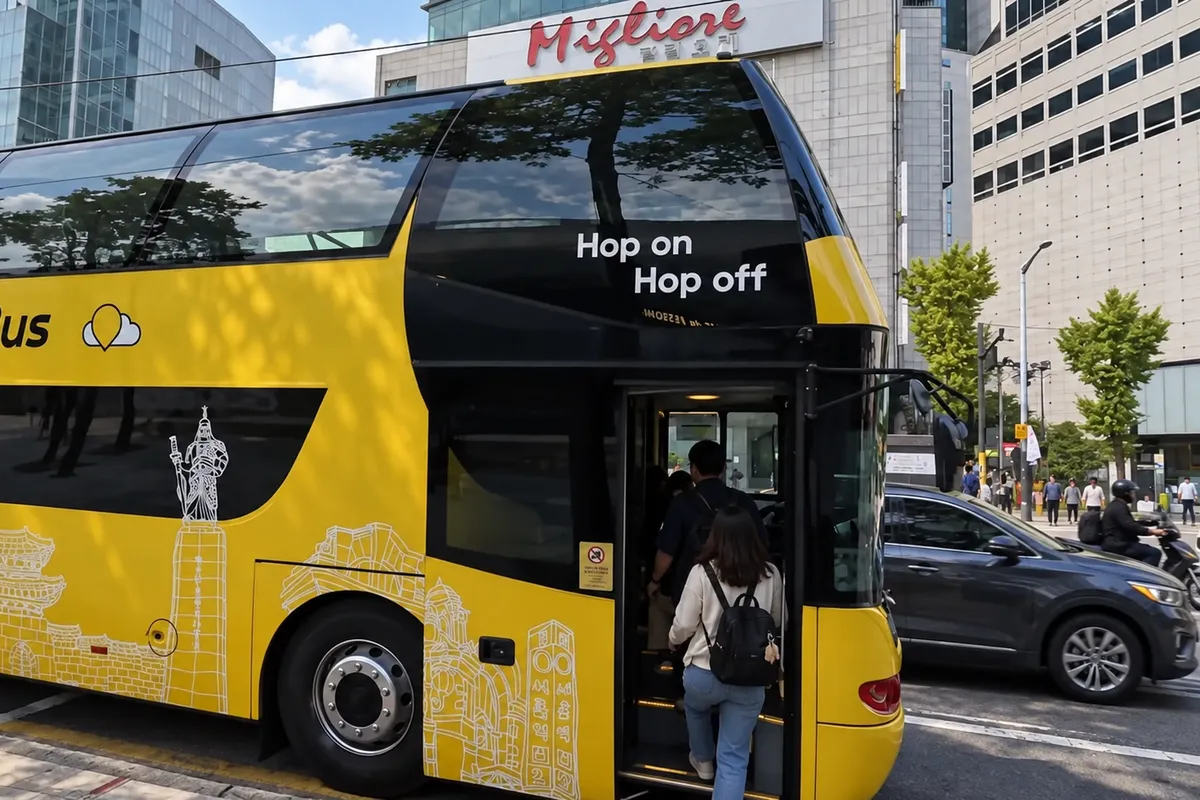
Both tours leave from the Gwanghwamun ticket booth at 68-2 Taepyeong-ro 1-ga, Jung-gu, near the Koreana Hotel. This is the red Tiger Bus operation, not Yellow Balloon City Bus, which uses Dongdaemun Design Plaza as its departure point. Similar names, different bus, mildly annoying start to a holiday if you go to the wrong one.
- From Gwanghwamun Station on Line 5, use Exit 6. The booth is about 100 metres away.
- From City Hall Station on Lines 1 or 2, use Exit 3 and walk roughly 300 metres straight.
- Show your paper boarding pass to the driver when you board. An online reservation by itself is not the pass.
I would take the subway. Gwanghwamun is a busy government and business district, and driving adds traffic and parking to a tour that already depends on road conditions. If you do bring a car, arrange a public car park separately rather than expecting parking at the booth.
Open-Top, Glass-Top and Semi-Open Buses
You cannot request a particular vehicle. Seoul City Tour Bus assigns the fleet according to bookings, traffic and vehicle condition, so a Seoul open top bus tour can become a glass-roof or semi-open ride on the day.
| Bus type | Seats | What it means on board |
|---|---|---|
| Open-top double-decker | 70 | 59 upper-deck seats and a retractable roof; best open-air views when the roof is back |
| Glass-top double-decker | 71 | Glass roof, heating and air conditioning; better shelter, less wind in your photos |
| Semi-open single-decker | 45 | Retractable roof, but no elevated upper-deck viewpoint |
Every bus has an audio guide in 12 languages. Ask for earphones at the booth instead of assuming a pair will be waiting on your seat. I would collect them while collecting the boarding pass and save a second trip.
Food, coffee and other drinks cannot come aboard, and pets are not allowed. On an open-top double-decker, everyone upstairs must remain seated. Buses run in rain and snow; the open bus can close its roof, although that rather removes the reason for choosing an open deck.
Departure Times, Mondays and First-Come Seats
The Downtown, Palaces & Namsan Course starts at 09:20 from Gwanghwamun, with the last departure at 16:50. Buses are scheduled every 25 minutes. That is the planned interval, not a promise that one will appear at an intermediate stop exactly 25 minutes after the previous bus.
There are no reserved seats, even with an advance booking. If the bus is full, you wait for the next one. I would begin at Gwanghwamun and avoid treating the last departure as a sensible time to start a palace-filled day.
The day route closes on Mondays. When Monday is a national holiday, it runs and the rest day moves to Tuesday. That holiday rule can catch out anyone building a neat palace itinerary around a long weekend.
Downtown Palace Namsan Route: Where the Day Pass Helps
Palaces, Insa-dong, Bukchon and the Blue House
TOUR01 serves Changgyeonggung Palace and Changdeokgung Palace, then Insa-dong and Bukchon, Cheongwadae, Gyeongbokgung Palace and Gwanghwamun Square. The stops make the geographical order easy to understand, which is useful on a first visit when palace names start blurring together.
Your Seoul sightseeing bus ticket covers the ride, not admission to Gyeongbokgung, Changdeokgung or Changgyeonggung. Budget and time for those separately. I would choose one palace properly rather than collect three entrance photos and remember mostly ticket queues.
Cheongwadae is another boundary worth understanding. The stop gives access to the Blue House neighbourhood and exterior views, but the bus pass does not include entry to the building or a guided visit. It is a stop on the route, not a bundled attraction ticket.
Myeong-dong, DDP and the Useful N Seoul Tower Stop
The urban part of the route includes Myeong-dong, Namsangol Hanok Village, Dongdaemun Design Plaza and Dongdaemun Market, Daehak-ro, and several hotel stops around Namsan. It is a broad orientation loop, not a route built only around royal history.
The N Seoul Tower bus stop is the strongest practical advantage. General vehicle access to Namsan has been restricted, as explained in the N Seoul Tower arrival guidance. The tour bus takes you up the road without making you solve the cable car, shuttle and uphill-walking puzzle yourself.
I would not hop off at every shopping stop just because it is there. Myeong-dong and DDP are easy to revisit independently. Namsan is the stop where the bus does something visibly more awkward by other transport.
A Realistic Hop-On Hop-Off Plan
The pass allows unlimited rides at all 15 stops on the travel date. Unlimited, however, does not mean infinite daylight. The 90-minute no-stop circuit is only the baseline; add palace visits, walking time and at least the scheduled 25-minute interval whenever you return to a stop.
Three or four meaningful stop-offs are a sensible upper target. I would pick N Seoul Tower, one palace and Insa-dong or Bukchon, then add DDP only if the day is running well. Trying to tick all 15 stops turns the pass into an expensive exercise in checking your watch.
Traffic, protests, events and road controls can delay arrivals around central Seoul. Keep one fixed reservation, such as a timed palace tour or dinner, out of the tightest part of your bus itinerary. The timetable is a planning tool, not a protective spell.
Han River Namsan Night Tour: A Different Kind of Ticket
Ninety Minutes, One Loop and One Photo Stop
TOUR04, the Han River Namsan Night Tour, also leaves from Gwanghwamun, but it is not hop-on hop-off. It is one 90-minute circular ride with a single 25-minute photo stop at N Seoul Tower. You cannot use it as an evening shuttle between Myeong-dong, the river and your hotel.
The appeal is simple: sit above traffic, watch the city lights and riverfront, then get a short tower stop before returning. I prefer the honesty of that format. There is no pretending you will see ten attractions in depth; you are buying a night ride and a skyline pause.
The 25 minutes go quickly, so decide whether you want photographs or a longer look at the view before stepping off. This is not the ticket for an unhurried evening at the tower.
Seasonal Departures, Ten-Passenger Minimum and Backup Plans
The night tour leaves at 19:00 from January through April and September through December. From May through August, departure moves to 19:30. It runs once daily and is closed on Mondays, with the same holiday-Monday-to-Tuesday rest-day switch as the day route.
Same-day online booking is unavailable. Call 02-777-6090 to ask about remaining seats before travelling to the booth. The tour also needs at least 10 passengers; below that number, it does not depart.
I would have a backup rather than build the whole evening around one departure. The Namsan 01 shuttle is the straightforward independent alternative for the tower, while Myeong-dong works for an easy evening on foot. Arrive around 40 minutes before departure if you are riding: you still need the paper pass, and seats within the assigned bus remain first come, first served.
Seoul Sightseeing Bus Ticket Prices and Booking Rules
Day and Night Fares, Children and What Is Included
For 2026, the advance online day fare is ₩27,000 for adults and ₩19,000 for children, reduced from list fares of ₩36,000 and ₩22,000. The night tour costs ₩25,000 for adults and ₩16,000 for children online, reduced from ₩29,000 and ₩18,000. These are route fares rather than seasonal prices; see the day-course fares and night-course fares.
| Ticket | Adult online | Child online | Ride allowance |
|---|---|---|---|
| Downtown, Palaces & Namsan day pass | ₩27,000 | ₩19,000 | Unlimited rides at 15 stops on the travel date |
| Han River Namsan Night Tour | ₩25,000 | ₩16,000 | One 90-minute loop with one 25-minute tower stop |
Child fares apply from 48 months through age 18. One child under 48 months per accompanying adult rides free, without a separate seat. Both fares include the 12-language audio guide, with earphones available from the booth. Palace admission and Blue House entry are extra or separate arrangements.
Online Booking Versus Same-Day Booth Purchase
Book online no later than the day before your ride. Same-day online sales close for both courses. For the day tour, you can instead buy at Gwanghwamun; for the night tour, call first to check space before making the trip.
The collection process has one extra step that is easy to miss:
- Go to the Gwanghwamun ticket booth before joining the boarding queue.
- Give the name used for the reservation.
- Collect the physical boarding pass, then show it to the driver.
I would not arrive at departure time with only a phone confirmation. You have not finished boarding admin until that paper pass is in your hand.
Cancellation Fees and the Night-Tour Noon Cutoff
The refund schedule gets less generous as the ride approaches. These are the Seoul City Tour Bus refund rules:
- Three days before boarding: 100% refund.
- Two days before: 90% refund.
- One day before: 80% refund.
- On the boarding day: 70% refund.
The night tour has the sharper edge: cancel after 12:00 on the travel date and there is no refund. I would book the day pass once my itinerary is fairly settled, and be even more cautious with the single nightly departure.
Seoul City Tour Bus Review: Comfort, Crowds and Trade-Offs
Full Buses, Traffic and Weather Exposure
The awkward moment is not the first departure; it is reboarding at a popular intermediate stop. If an arriving bus already has no free seats, your valid pass does not create one. You wait for the next bus, and another delay can stretch that beyond the scheduled 25 minutes.
Afternoon congestion around Jongno and Sejong-daero can also stretch the loop. Add a downtown rally or road closure and the neat timetable becomes more of a suggestion. I would leave buffer time instead of chaining the bus to a flight, train or timed show.
Comfort depends heavily on the vehicle you happen to get. Summer sun feels stronger on an exposed upper deck, while winter wind makes a short photo session feel much longer. Bring sun protection in warm months and a proper outer layer in cold ones. In rain, the closed roof keeps you drier but trades away the open view.
Traffic and engine noise are part of the ride too. Use the supplied audio system with earphones, and do not expect upper-deck conversation or commentary to float peacefully above a busy junction.
Day Tour Versus Night Tour
The day pass buys flexibility: 15 stops, palace access points, Namsan and unlimited reboarding on that date. Its cost is time spent managing stops and queues. The night tour buys simplicity: one departure, one loop and no decisions beyond being there on time.
For photography, I would choose daylight for palace roofs, traditional streets and city layout. For illuminated bridges and the skyline, the night course is the obvious fit. Its 25-minute tower stop is brief, though, so keen tower visitors should return independently.
| Your priority | Better fit | Main compromise |
|---|---|---|
| Active sightseeing and several stop-offs | Day pass | Traffic and waiting between rides |
| A low-effort evening skyline ride | Night tour | No hop-on hop-off freedom |
| A long visit to N Seoul Tower | Independent Namsan transport | More route planning |
My Final Take: Tiger Bus or Seoul Public Transport?
Who Should Buy It and Who Should Skip It
I would recommend the day pass to first-time visitors who want an easy mental map of central Seoul, travellers who prefer one boarding system to repeated subway navigation, and anyone keen on elevated street photography. The direct Namsan stop gives the ticket a genuine use beyond sightseeing fluff.
The night tour suits someone who wants a contained evening activity and is happy with one scheduled loop. It is less suitable for anyone hoping to linger at the tower or improvise dinner stops along the way.
Skip both if you are a fast solo traveller, counting every won, or trying to keep pinpoint appointments. Also think twice if your only available day is already packed with timed palace and museum bookings. A hop-on pass needs loose time; otherwise you pay for flexibility and then refuse to use it.
The Cost Test and My Buying Rule
Seoul’s adult subway base fare is ₩1,550 with a transport card. Four or five separately charged base journeys cost ₩6,200–₩7,750, before any distance surcharge; transfers within 30 minutes can lower the total. The Seoul Metropolitan Government subway fare table explains the card fare and transfer window.
That makes the ₩27,000 day pass several times the cost of an ordinary transport day. I use the same distinction in my hop-on bus versus public metro and city bus cost test: the tour ticket is for views and easier orientation, not transport savings.
| Choose this | When it makes sense |
|---|---|
| Tiger Bus day pass | You want palaces and Namsan on one scenic circuit and will make three useful stop-offs |
| Tiger Bus night tour | You want one relaxed 90-minute skyline ride and accept the passenger minimum |
| T-money and Seoul Metro | You want the cheapest, most direct way between individually chosen sights |
What to check before you go
- Check the final KRW price for your date at checkout, especially for a same-day booth purchase.
- If driving, find a public car park near Gwanghwamun and check its hourly rate before setting off.
My money goes on the day pass only when Namsan and an open-deck city overview are part of the plan. For a palace-heavy day with fixed times, I would take the metro and keep the ₩27,000 for admissions and dinner.