

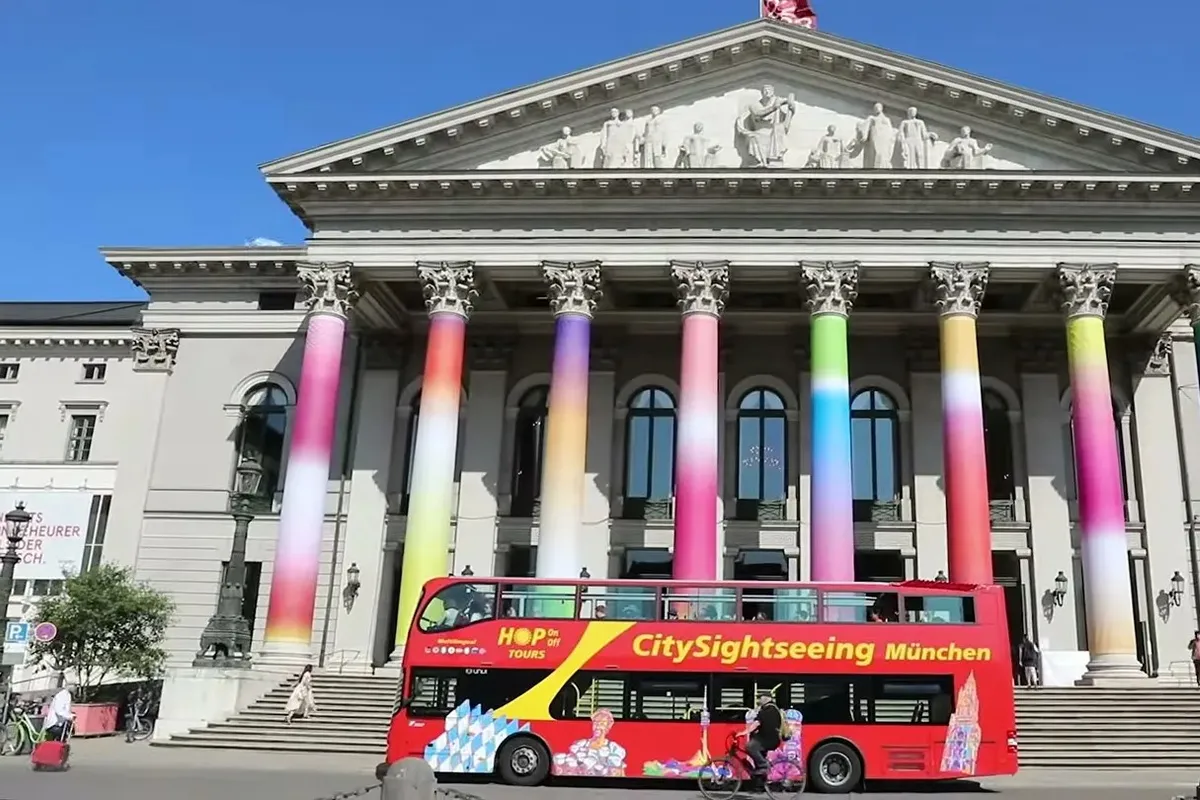
City Sightseeing's 24-hour pass costs €28.90 online; Munich's MVV Single-Tageskarte for zone M costs €10.10 and already reaches Nymphenburg, the Olympic park and Schwabing by tram, U-Bahn and bus. The extra €18.80 buys an open upper deck and a recorded commentary. It does not buy speed. The Red Line's scheduled hour around the Old Town is often the slowest way to cover it, and all three loops return to the same station before you can switch.
The red buses are run by Yellow Cab Verkehrsbetriebs GmbH under the City Sightseeing brand; Gray Line's blue buses are run locally by Münchener Stadtrundfahrten. They start at different hubs, charge almost identical walk-up fares and make different compromises on route shape. That is the useful comparison for anyone deciding between a bus ticket and a transit ticket.
Where the Buses Leave From
The Hauptbahnhof stop
All three City Sightseeing loops start and finish at Luisenstraße 4, on the curb in front of the Elisenhof and facing Bahnhofsplatz. Leave the station by the north exit toward Arnulfstraße and Luisenstraße; the stop is on the street, not inside the covered bus station. The address is worth checking because the station has several exits, and the wrong one adds a walk around the block.
The station is the main junction for the S-Bahn trunk line: S1 and S8 run to the airport, while S2 to S7 share the same tunnel through the city. U1, U2, U4 and U5 stop underneath; the MVG Hauptbahnhof station guide shows which exit puts you on Bahnhofsplatz. Trams and city buses stop at street level. From Karlsplatz, the walk takes about 10 minutes and is flat.
Parking is expensive at the station. The DB garage under the south side, Tiefgarage München Hauptbahnhof Süd at Senefelderstraße 6, charges €3.30 an hour and €32 a day, with 242 spaces and one accessible bay, according to DB's parking page for München Hbf. The Hopfenpost garage at Hopfenstraße 6 is a 10-minute walk north, costs €3.00 an hour and €17 a day, and is closed on Sundays. For a day trip, that is the difference between a €32 parking bill and a €17 one.
Boarding
There are no reserved seats and no online seat selection. The queue forms on the sidewalk, the upper deck fills first, and the 10:00 departure is the one most likely to leave people behind on a summer weekend. The operator's own advice is to arrive early; 15 minutes is enough on a normal weekday, 25 on a Saturday in July.
For the front row on a dry day, join the 10:00 queue at the Elisenhof by 09:40. The upper deck fills from the front, and the next departure usually has only the back rows left.
The first time I joined the 10:00 queue at the Elisenhof, I was still buying a paper ticket when the bus filled. The attendant sent the overflow to the next bus, which was fine, but I lost the front row and spent the first loop looking at the back of a school group. Now I buy the QR code on my phone the night before, join the boarding line and skip the sales queue, and take the 10:00 with a coffee from the bakery inside the station. The coffee was still too hot to drink when we pulled out.
If you buy at the stop, cash is accepted on the bus. The online price is about 10% lower; the fare table below has the exact prices.
The Three Loops and What Each One Reaches
City Sightseeing sells Munich as three one-hour loops. Only the Red Line runs often enough to work as a true hop-on hop-off service; the Purple and Blue lines are closer to scheduled excursions. All three return to Hauptbahnhof, so switching loops costs you a wait at the station.
Red Line: The Old Town Circuit
The Red Line is the one to take first if you have only a morning. It leaves Hauptbahnhof at 10:00, reaches Odeonsplatz at 10:15, Marienplatz/Tal at 10:25, the opera at Max-Joseph-Platz at 10:30, Wiener Platz in Haidhausen at 10:40 and Karlsplatz/Stachus at 10:50, then returns to the station around 11:00. Those are the operator's published stop times.
The stop count is the first thing to get straight. The route description on City Sightseeing's own Red Line page says the drivers stop at seven places; the table underneath lists six, numbered H1 to H6, and the booking page also says six. I plan on six. If a seventh stop exists, it has no published departure time.
The route circles the pedestrian zone. From the station it passes the Alter Botanischer Garten, Königsplatz and Karolinenplatz before Odeonsplatz, then follows Maximilianstraße east past the Maxmonument and over the Isar to the Maximilianeum and Haidhausen. It returns through the Glockenbachviertel and Sendlinger Tor to Karlsplatz. You get the royal avenues and the river, but the Glockenspiel is a five-minute walk from the Marienplatz/Tal stop. The bus also passes Königsplatz without stopping; if the Glyptothek is the goal, walk back from Odeonsplatz, about 10 minutes.
The 10:00 loop has about ten minutes of slack between Stachus and the station. At 11:00, when Maximilianstraße and the Isar bridges are busiest, I budget 75 minutes for the same circuit and treat anything earlier as a bonus. If you are catching a train, take the U-Bahn; the bus is not a timetable you can rely on in the middle of the day.
If you plan to use the loops as transport, the transfer point is always Hauptbahnhof. The route-by-route guide to the Munich loops shows how to sequence the Red and Purple lines without backtracking through the centre.
Purple Line: Nymphenburg and Olympiapark
The Purple Line is the most useful of the three for a short trip. It leaves Hauptbahnhof at 10:00, calls at Rotkreuzplatz/Neuhausen at 10:10, Nymphenburg Palace at 10:15 and the Olympiapark at 10:30, then runs back to the station. The palace and the Olympic grounds sit on opposite sides of the western suburbs; doing both by public transport means a tram to Nymphenburg and a U-Bahn or bus across the park. The bus solves that routing problem in half an hour.
In summer the Purple Line runs often enough to plan around. In winter it drops to four departures a day on weekdays, two hours apart, and hourly at weekends. The comparison table below has the exact frequencies. The practical consequence is that a winter weekday at Nymphenburg gives you a two-hour window: the 10:15 arrival must be back at the stop by 12:15, or you are waiting until 14:15.
One winter Tuesday I misjudged that gap: I stayed for the palace tour, came out to see the 14:15 bus pulling away and faced a two-hour wait. Tram 17 at Schloss Nymphenburg got me back to Hauptbahnhof in about 20 minutes, and the MVV day ticket covered it. I now check the winter headway before I get off, and I treat the tram as the fallback instead of standing by the canal.
The palace stop is at the Schloss Nymphenburg bus stop, close to the forecourt and the canal; the main entrance is a short walk. The Olympiapark stop is the parking deck at the Olympiaturm, on the north side of the park. That is convenient for the tower and the stadium, less so for BMW Welt: the complex is across the park, about a 10-minute walk, and the U3 from Olympiazentrum is the quicker way back if you end there. The bus passes BMW Welt but does not stop at it.
The palace, the Marstallmuseum and the Amalienburg are separate visits; the park itself is free, and the canal path gives you the best view of the facade. The bus does not wait, and the last departure from Nymphenburg in winter is at 16:15, so the palace is a morning stop.
Blue Line: Schwabing, the Pinakotheken and the English Garden
The Blue Line is the one people misread. It does not go through Königsplatz; that is the Red Line. From Hauptbahnhof it runs via Promenadeplatz to Odeonsplatz, then north up Ludwigstraße, under the Siegestor, along Leopoldstraße and back through the museum quarter. The published stops are Hauptbahnhof (10:30), Odeonsplatz (10:40), Thiemestraße/English Garden (10:55), Leopoldstraße/Hohenzollernstraße (11:00), Siegestor (11:05) and Pinakotheken/Theresienstraße (11:15).
The frequency is the trap. On weekdays the bus leaves Hauptbahnhof at 10:30, 12:30, 14:30 and 16:30, all year; at weekends and on public holidays it runs hourly from 10:30 to 16:30. If you get off at the Pinakotheken at 11:15 on a Tuesday, the next bus is 13:15. That is fine if you are spending two hours in the Alte Pinakothek; it is a waste of a 24-hour pass if you only wanted a quick look.
The Neue Pinakothek has been closed for renovation since 2019; the Pinakothek's visitor page gives 2029 as the planned reopening, with 19th-century works on show on the ground floor of the Alte Pinakothek and in the Sammlung Schack. Do not build a day around the old building. The stop is still useful for the Alte Pinakothek and the Pinakothek der Moderne, both within a short walk, and for the Brandhorst collection across the street.
The English Garden stop is another case of a name doing too much work. Thiemestraße is on the southern edge of the park; the Chinese Tower beer garden is about 15 minutes north on foot. If the beer garden is the plan, bus 54 or 154 to Chinesischer Turm, or the U3/U6 to Giselastraße and a 15-minute walk, puts you closer. The Blue Line's stop is for the Eisbach wave and the southern lawns.
Sit on the right-hand side upstairs. The operator's own Schwabing notes say most of the sights are on the right, and the view down Leopoldstraße to the Siegestor is the reason to take this loop instead of the U3. The left side gets the university buildings; the park is on the right.
Ticket Prices, Passes and the Fine Print
City Sightseeing's fare table is simple once you strip out the family rows. The single City Tour ticket is valid for one circuit; it does not run for a day. You can get off and back on along the way, but you cannot start a second loop. The 24-hour pass covers all three lines and unlimited boarding from the moment the QR code is scanned. The 48-hour pass costs €4.00 more online than the 24-hour pass, so it is worth taking only if you have a second day.
| Ticket | City Sightseeing online | City Sightseeing at stop | Gray Line online | Gray Line at stop |
|---|---|---|---|---|
| 24-hour adult | €28.90 | €32.00 | €28.80 | €32.00 |
| 24-hour child | €15.50 (5–15) | €17.00 | €15.30 (4–14) | €17.00 |
| 24-hour family | €60.90 (2 adults + up to 3 children) | €65.00 | €58.50 (2 adults + up to 4 children) | €65.00 |
| 48-hour adult | €32.90 | €37.00 | €34.60 | €38.50 |
| 48-hour child | €15.50 | €17.00 | €18.00 | €20.00 |
| 48-hour family | €69.90 (2 adults + up to 3 children) | €75.00 | – (not listed) | – (not listed) |
| Short loop, adult | €24.50 (Red Line, one circuit) | €27.00 | €24.30 (Express, 24 hours) | €27.00 |
| Short loop, child | €15.50 | €17.00 | €15.30 | €17.00 |
Fares from City Sightseeing's fare page and Münchener Stadtrundfahrten's fare page. City Sightseeing's child fare covers ages 5–15; Gray Line's covers 4–14. Children under 5 travel free on City Sightseeing without a seat; children under 4 travel free on Gray Line. City Sightseeing's single ticket is one circuit; Gray Line's Express is a 24-hour ticket on the 7-stop city loop.
The single ticket is the worst value. The gap to the 24-hour all-lines pass is €4.40, and it confines you to one hour on the Red Line. Unless you have exactly one hour and no interest in Nymphenburg or Schwabing, the 24-hour pass is the better buy. The 24-hour pass is the tier I would choose for a first visit.
The walk-up prices are identical for the 24-hour adult, child and family tickets. Online, the two operators sit within a few euros of each other; City Sightseeing's 48-hour adult pass is €1.70 cheaper, and Gray Line's family pass is €2.40 cheaper.
Two rules catch people out. First, the 24- and 48-hour passes run from the moment of redemption, not from a calendar day. Scan at 15:00 on Friday and a 48-hour pass runs until 15:00 on Sunday, which the FAQ calls two consecutive days but is really a rolling window covering three dates. The difference between calendar-day and rolling tickets matters here. Second, the voucher's shelf life is contradictory: the FAQ says one year from purchase, while the terms and conditions say the QR code expires at the end of the third calendar year after purchase. The terms are the contract you accept at checkout, so the longer period should apply, but screenshot the checkout page and the confirmation email in case the office reads the FAQ instead.
Refunds are the other trap. The terms exclude the statutory right of withdrawal for dated leisure services and give no contractual right to cancel, return or exchange an online ticket. That is the operator's contract, not legal advice; if you need flexibility, Gray Line's free cancellation up to 24 hours before departure is the safer booking.
City Sightseeing runs rain or shine. A wet forecast does not unlock a refund, so the weather is the one thing worth checking before you pay.
My booking routine is boring: buy the 24-hour pass online the night before, after the 48-hour forecast is in, and do not buy the 48-hour pass unless the second day is already planned. The online discount is not worth losing flexibility weeks in advance, and the QR code is delivered immediately.
On Board: Roof, Seats, Audio and Access
The upper deck is the main reason to buy the ticket. The front rows are worth the extra 15 minutes of queueing; the back row sits over the engine and gets the vibration at every red light. On the Red Line, the front row gives you the cleanest angle of the Maximilianeum as the bus crosses the Isar.
The roof is a retractable canopy, and Munich's weather decides how much of the upper deck you actually get. In rain the crew closes it, the side glass fogs between Odeonsplatz and Schwabing, and the open-air selling point disappears. On a wet autumn morning on the Blue Line, the front two rows cleared first because the windscreen vents run along the front; the rest of the deck stayed steamed up until we reached the English Garden. Carry a waterproof and sit forward if the sky is doubtful.
Traffic is route-specific. The Red Line's worst stretch is between Sendlinger Tor and Karlsplatz, where the bus shares a narrow lane with delivery vans and the lights are short. The Purple Line is smoother once it leaves Rotkreuzplatz, but the canal approach to Nymphenburg can crawl in the afternoon. The Blue Line's weak point is the Siegestor intersection. None of this is visible from the timetable, which is why the 75-minute buffer on the Red Line is worth keeping.
The audio guide is recorded, not live, and it comes in German, English, French, Italian, Japanese, Norwegian, Russian and Spanish. Across the three loops, the English track covers the Residenz, Ludwig I's building programme, the Maximilianeum and the 1972 Olympics in a compressed script. The seat jacks are standard 3.5 mm, so bring your own wired headphones; the earbuds handed out at boarding work, but they are the weakest part of the system. The GPS trigger is the other weak link: when the bus is held at the lights on Maximilianstraße, the track for the Maximilianeum can finish before you get there, and the next few minutes are music.
All City Sightseeing buses are barrier-free and carry ramps, according to the operator. The upper deck is reached by stairs, so wheelchair users get the lower deck: functional, but at street level and behind tinted glass. The lower deck also fills first when it rains, which matters if you are travelling with someone who cannot manage the stairs.
How It Compares With Gray Line and the MVV
City Sightseeing vs Gray Line
Gray Line's Munich operation runs blue double-deckers from Sonnenstraße 3 at Karlsplatz/Stachus, not from the Hauptbahnhof. That address is the first practical difference: if you are staying in the Altstadt, Gray Line's start is a shorter walk; if you are arriving by train, City Sightseeing's Elisenhof stop is easier.
Gray Line sells one Grand Circle of 11 stops that takes about 2.5 hours, plus a 7-stop Express loop of about an hour. The Grand Circle includes Nymphenburg, BMW Welt & Museum, the Olympiapark and Schwabing in one sitting. City Sightseeing splits similar ground into three one-hour loops and makes you return to Hauptbahnhof to switch. Gray Line's single loop is the more efficient way to see the outer sights; City Sightseeing's shorter loops are easier to fit around a museum or a long lunch.
Gray Line's Grand Circle runs roughly every 20–30 minutes in summer and hourly in winter. City Sightseeing's Red Line is the only one of its three loops that runs often enough to behave like a city bus; the Purple and Blue lines are scheduled excursions. The comparison table below has the frequencies side by side.
Coverage differs at the edges. Gray Line's route includes BMW Welt & Museum and the Deutsches Museum; City Sightseeing's Purple Line passes BMW Welt but stops at the Olympiaturm car park, and its Red Line does not go to the Deutsches Museum. City Sightseeing stops at Wiener Platz/Haidhausen, which Gray Line does not. Munich Tourism's Gray Line page currently lists the Deutsches Museum stop as cancelled for construction, so check before you plan a museum drop-off.
On price, the 24-hour walk-up fares are identical and the online fares differ by a few euros; the family pass is the only row where the gap is worth noting. The bigger difference is cancellation: Gray Line allows free cancellation up to 24 hours before departure, while City Sightseeing's terms give no contractual right to cancel. If your plans are weather-dependent, that is worth more than the small fare differences.
| City Sightseeing | Gray Line | |
|---|---|---|
| Start | Hauptbahnhof, Luisenstraße 4 | Karlsplatz/Stachus, Sonnenstraße 3 |
| Loops and stops | 3 loops; 15 published stops | Grand Circle 11 stops; Express 7 stops |
| Loop duration | 60 minutes each | Grand Circle 2.5 hours; Express 1 hour |
| Summer frequency | Red 15 minutes at weekends and holidays, 30 minutes Monday–Friday; Purple 30 minutes; Blue four times on weekdays, hourly at weekends | Every 20–30 minutes |
| Winter frequency | Red 30 minutes; Purple every 2 hours Monday–Friday, hourly at weekends; Blue four times on weekdays, hourly at weekends | Hourly |
| Olympiapark access | Purple Line, 30 minutes from Hauptbahnhof; BMW Welt about a 10-minute walk from the stop | Grand Circle, near the end of its 2.5-hour loop; direct Olympiapark/BMW Welt & Museum stop |
| Coverage | Old Town, Nymphenburg, Olympiapark, Schwabing, Haidhausen | Old Town, Kunstareal, Nymphenburg, BMW Welt, Olympiapark, Schwabing |
| Cancellation | No contractual right | Free up to 24 hours before departure |
| Audio and Wi-Fi | 8 languages; no Wi-Fi advertised | 9 languages; free Wi-Fi |
Times from City Sightseeing's timetable and Münchener Stadtrundfahrten's route page. City Sightseeing switches to the winter timetable on 1 October and back on 1 April; Gray Line's winter timetable also starts in late October. Schedules and fares change, so confirm on the operator's page before you travel.
The bus pass vs the MVV day ticket
The MVV comparison is where the bus ticket has to justify itself. A Single-Tageskarte for zone M costs €10.10 and is valid on the S-Bahn, U-Bahn, tram and city bus until 06:00 the next morning, per the MVV Single-Tageskarte page. Since January 2026, children aged 6–14 travel free on that ticket (own children unlimited, other children up to three), so a couple with three children pays €20.20 for two adult day tickets. The group day ticket for up to five people is €19.70. Against the City Sightseeing family pass, the saving is over €40.
The MVV ticket also reaches the same sights. Tram 17 from Hauptbahnhof to Schloss Nymphenburg takes about 20 minutes and drops you at the palace canal. The U3 from Marienplatz to Olympiazentrum takes about 10 minutes, and BMW Welt is a 5–7 minute walk from the station. Schwabing is on the U3/U6. The bus pass buys the open deck and the commentary; the transit ticket buys access.
The cost per stop makes the point. The 24-hour pass works out at €1.93 per published stop if you ride all 15, and at €7.23 a stop if you use four. The MVV day ticket is €10.10 for the whole network. If you value the tour, the per-stop maths is the wrong lens. If you are buying transport, it is the right one.
Where the bus wins is the outer loop. Nymphenburg and the Olympiapark are a tram plus a U-Bahn plus a walk on public transport; the Purple Line does it in 30 minutes from the station and gives you a seat between them. If that pairing is your day, the pass earns its price. If you are staying in the Altstadt and visiting museums, the MVV ticket and your feet are cheaper and faster.
Tram 19 is the local version of the same ride. From Karlsplatz it runs past the Nationaltheater and the Maximilianeum to Berg am Laim; a normal MVV ticket covers it, and you can ride it in both directions for less than a bus ticket. There is no commentary, but the view of Maximilianstraße from a tram window is the same street the red bus uses. Munich's city portal lists it among the city-centre routes.
Who Should Ride, and Who Should Take the Tram
The bus is a good fit for a first visit of 24 to 48 hours, for anyone who cannot walk long distances, and for families who want Nymphenburg and the Olympiapark without changing trains. It is also a decent rain plan if you sit downstairs, though the view suffers. The open deck is the point; if the roof is closed, the value drops sharply.
It is a poor fit for a museum-heavy day. The 24-hour clock runs while you are inside the Alte Pinakothek or the Deutsches Museum, and the bus sits in traffic outside. It is also a poor fit for a budget trip: the MVV day ticket covers the same ground, and children ride free with an adult on the Single-Tageskarte. And it is a poor fit for anyone who mainly wants the Old Town: the bus circles the pedestrian zone, so you will still walk the Glockenspiel, the Viktualienmarkt and the Frauenkirche.
Two things I would skip. The single City Tour ticket is one circuit, and the gap to the 24-hour all-lines pass is only €4.40; unless your schedule is exactly one hour, it is false economy. The Blue Line's English Garden stop is the other: if the Chinese Tower is the goal, the 15-minute walk from Thiemestraße makes the bus a poor delivery system. Take bus 54 or 154 instead.
The 24-hour pass is the tier I would buy. The 48-hour pass only makes sense if you have a full second day and the weather holds; otherwise you are paying for a day you will spend in a museum or on a train. The family pass is cheaper than two adult passes plus one child fare, so it pays from the first child; for two adults travelling alone, it does not.
My verdict is narrow. Buy the 24-hour pass online if you want the open deck and plan to use the Purple Line for Nymphenburg and the Olympiapark; the Red Line alone is not worth the money. If you are treating the bus as transport, take the MVV day ticket, the tram to Nymphenburg and the U3 to Olympiazentrum. If the forecast is dry and you have one day, start with the 10:00 Red Line, switch to the Purple Line after lunch, and buy the pass the night before. If it is raining, the MVV ticket and the U3 are the better day.