

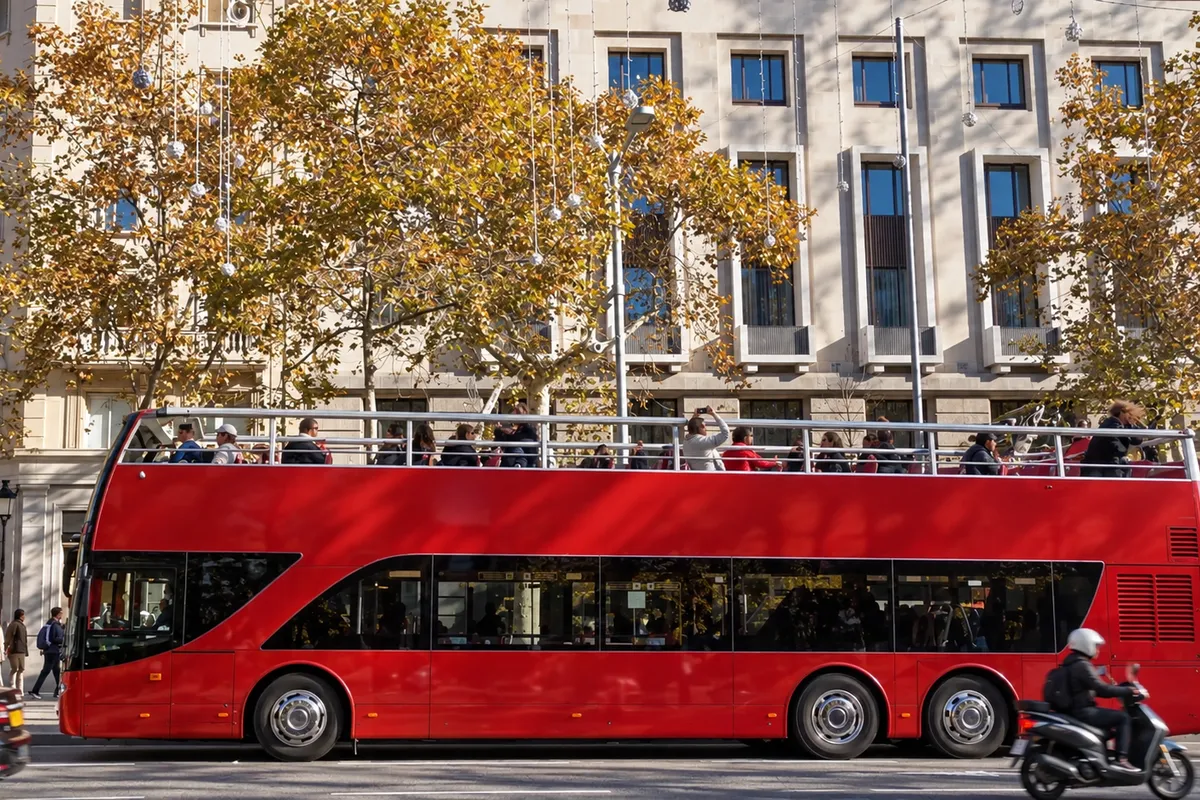
Barcelona's official sightseeing bus is run by TMB and Turisme de Barcelona, and it has been circling the city since 1987. A one-day adult pass costs €29.70 online or €33 at the kiosk; two days cost €39.60 or €44. The ticket buys unlimited rides on the Blue and Red loops, a 16-language audio guide, and a seat above the traffic. It does not buy entry to a single Gaudí interior, and it is a slow way to cross town. The question is whether the views and the Montjuïc climb are worth the premium over a €13 T-casual card.
How the Official Bus Turístic Network Works
Plaça de Catalunya and the Boarding Routine
Both loops start and finish at Plaça de Catalunya, which is also the easiest place to ask staff a question or pick up a route map. The square sits on metro lines L1 and L3, Rodalies and FGC trains, and a cluster of TMB city buses, so you can reach it from almost anywhere in the city. The Hola Barcelona store in the L3 metro lobby sells tickets at the desk price and is useful if you have not bought online.
A ticket lets you board at any marked stop, not just the terminus. Boarding at an intermediate stop saves you the queue at the square, but the bus may arrive full. The first departure of the morning is the safest bet if you want a seat upstairs.
On my last ride I reached the square at 8:45. The line already ran past the kiosk, and the 9:00 departure left with every top-deck seat taken. I sat downstairs to La Pedrera, then moved up when a family got off. That is the ordinary morning pattern, not a bad-luck day.
Driving to the square is a waste of time. The closest garage is the Saba car park under the square, and the tour has no parking of its own. Use the metro.
Hours, Frequency, and the 19:00 Cutoff
The daytime service runs every day except 1 January and 25 December. Buses start between 9:00 and 9:30 at most stops, and the last departure from Plaça de Catalunya is at 19:00 on both routes. That last departure is not the end of the loop; it is when the final bus leaves the square, so stops further out wind down shortly afterwards.
Headway is published as 10 to 25 minutes, and a full loop takes about two hours in clean traffic. The 19:00 finish is the same in January and July. Barcelona does not extend daytime hours in summer; the seasonal variation is in the separate night and Christmas tours, not in the day pass.
Morning traffic around Gran Via and Passeig de Gràcia can add half an hour to a loop. If you have a timed entry at the Sagrada Família or Park Güell, do not use the bus as your transfer; use the metro and walk.
Fleet, Decks, and Accessibility
The fleet is shifting to hybrid and electric buses, but the layout is the same: an open upper deck, an enclosed lower deck, and stairs between them. The upper deck is where the views are, especially along Passeig de Gràcia, where you look straight into the balconies of Casa Batlló and La Pedrera. When it rains, when the wind picks up, or when the top deck is full, the lower deck is the better seat.
The audio jacks are on the lower deck, at the seats. On the open deck, wind and traffic noise can swallow the commentary; the free earbuds are thin, and a pair of your own wired buds makes a real difference. I keep a foam-tip pair in my bag for this bus.
The lower deck is adapted like the rest of the TMB fleet, with a reserved wheelchair space and an audio induction loop for hearing-aid users. The upper deck is reached by stairs and is not step-free. If you use a wheelchair, plan on the lower deck and accept that the view is through the windows.
The rules are enforced: no standing on the top deck while the bus is moving, no eating or drinking, no umbrellas, and no e-scooters, unicycles or segways. Luggage and pushchairs go in the central space on the lower deck, next to the rear staircase. Groups are not guaranteed seats on the same bus.
Blue Route vs Red Route: What Each Loop Covers
Blue Route: Gaudí, Park Güell, and the Camp Nou Detour
The Blue Route is the Gaudí loop. It leaves Plaça de Catalunya, runs up Passeig de Gràcia past Casa Batlló and La Pedrera, continues to the Sant Pau Modernista site, and climbs to Park Güell. From there it crosses the ridge to Plaça Kennedy at the foot of the Tibidabo funicular, drops through Sarrià, and returns via Les Corts, Camp Nou and the Pedralbes monastery.
Two stops need a warning. The Park Güell stop is on Travessera de Dalt, not at the monument gate; the walk up Carrer de Larrard takes about 15 minutes and is steep in the heat. The Tibidabo stop is Plaça Kennedy, at the bottom of the funicular, not the amusement park at the top. The Tramvia Blau terminus is there too, but the historic blue tram has been out of service since 2018 and restoration work is not due to start until late 2027.
Camp Nou is the other changed stop. The stadium reopened for matches in November 2025 and has been operating at a capacity of about 62,000 since March 2026, but the redevelopment is not finished: the roof and third tier are still to come, and the project's published timetable puts full completion in late 2027 at the earliest. The FC Barcelona stop on the Blue Route is out of service. Use Les Corts or Palau Reial–Pavellons Güell and walk 10 to 15 minutes. The stadium tour is now the Barça Immersive Tour, with the museum, a 360-degree show and a viewing platform over the works; you cannot walk the full stadium.
Red Route: Montjuïc, the Port, and Sagrada Família
The Red Route is the hill-and-water loop. From Plaça de Catalunya it runs down to Plaça d'Espanya, climbs Montjuïc past the Poble Espanyol, MNAC, the Olympic Ring, the Joan Miró foundation and the Montjuïc cable car, then drops to the World Trade Center and Port Vell. It turns inland to the Arc de Triomf and the Sagrada Família, continues through Poblenou and the beaches, and comes back along the waterfront through Barceloneta and La Rambla.
The Montjuïc section is where the bus earns its keep. The funicular from Paral·lel gets you to the base of the hill, but the sights are spread across the ridge, and walking between the Joan Miró foundation, the Olympic stadium and the cable car is a lot of uphill pavement. The bus loops the whole cluster. The cable car is a separate ticket.
The Sagrada Família stop is on the square opposite the basilica, a two- to three-minute walk from the Nativity façade entrance. The basilica runs on timed entry and airport-style security, so the bus is only useful if you have a slot; it will not get you inside.
One route detail surprises people: both loops are one-way. From Plaça de Catalunya, the Red Route reaches the Sagrada Família only after most of the Montjuïc and port circuit. If you want to go straight there, take the metro.
The coastal stretch is the best part of the Red Route on a clear day, and the worst on a windy one. The upper deck has no shelter, and the bus picks up speed along the Poblenou beaches. I moved downstairs between Bogatell and Barceloneta on an autumn ride; the view went, but the windburn did too.
Gaudí Stops: Which Route, Which Stop, How Far
| Gaudí site | Route and stop | Walk from the bus | Entry |
|---|---|---|---|
| Casa Batlló | Blue or Red, Casa Batlló–Museu Tàpies | 0–2 minutes | Timed ticket; book ahead |
| La Pedrera (Casa Milà) | Blue, Passeig de Gràcia–La Pedrera | 1–2 minutes | Timed ticket; book ahead |
| Park Güell | Blue, Park Güell | 15 minutes uphill via Carrer de Larrard | Timed ticket for the Monumental Zone |
| Sagrada Família | Red, Sagrada Família | 2–3 minutes across the square | Timed ticket; separate security queue |
Two practical points are not in the operator's stop list. Park Güell has a free area and a paid Monumental Zone; the mosaic terrace, the Gaudí house and the best views need a timed ticket. The Sagrada Família security queue is separate from the entry time, so arrive early rather than cutting it fine.
If you plan two Gaudí interiors in one day, book the first slot at one and the last slot at the other. The bus loop between them can eat an hour, and timed entries do not wait.
Service Changes and Interchanges
The operator's service page lists the Torre Glòries–22@ stop on the Red Route as cancelled, with an alternative at Carrer de Badajoz, 160, and the Estació de Sants stop as cancelled. Those are the two changes most likely to catch someone using an old printed map. Matchdays at Camp Nou and events on Montjuïc can also close stops or delay the start of service; check the service information page on the morning you ride.
Switching loops is easy at Plaça de Catalunya and at the Casa Batlló–Museu Tàpies stop, which both routes serve. You do not need a new ticket; get off, cross to the other marked pole, and wait. The stop-by-stop Barcelona guide shows the full overlap if you want to plan the switch in advance.
Tickets, Fares, and the Calendar-Day Rule
Prices and What the Ticket Includes
Prices are set by the operator and are the same at the kiosk and online, minus a 10% web discount. The one-day adult pass is €33 at the desk and €29.70 online; two days are €44 and €39.60. Children aged 4 to 12 pay €18 or €16.20 for one day and €23 or €20.70 for two. Seniors aged 65 and over and visitors with a disability of more than 33% pay €28 or €25.20 for one day and €39 or €35.10 for two. Under-4s ride free. The complete schedule is on the official fares page.
The ticket includes unlimited boarding on both loops, a set of wired headphones, the 16-language audio guide, and a discount booklet for partner attractions. It does not include entry to Casa Batlló, La Pedrera, Park Güell or the Sagrada Família, and it does not reserve a seat. Buy monument tickets separately and in advance.
| Ticket category | 1 day, desk | 1 day, online | 2 days, desk | 2 days, online |
|---|---|---|---|---|
| Adult (13–64) | €33.00 | €29.70 | €44.00 | €39.60 |
| Child (4–12) | €18.00 | €16.20 | €23.00 | €20.70 |
| Senior (65+) | €28.00 | €25.20 | €39.00 | €35.10 |
| Disability (over 33%) | €28.00 | €25.20 | €39.00 | €35.10 |
| Under 4 | Free | Free | Free | Free |
The Calendar-Day Rule in One Example
The fare page calls these tickets 24 hours and 48 hours, but the purchasing conditions are explicit: they are valid for one calendar day or two consecutive calendar days, not for 24- or 48-hour periods. The one-day ticket expires at the end of service on the day you use it. In practice, that means 19:00.
Validate at 15:00 on a Tuesday and you have four hours, not until 15:00 on Wednesday. At €29.70, four hours works out at €7.43 per hour; a 9:00 start gives you ten hours at €2.97 per hour. The two-day pass at €39.60 covers 20 service hours, or €1.98 per hour. A 15:00 start costs €7.43 per hour; a 9:00 start costs €2.97.
Rolling 24-hour tickets are common in other European cities, which is why this catches people out. If you have used one in Madrid or Rome, the calendar-day versus rolling-ticket comparison explains the difference.
Buying, Voucher Validity, and Refunds
Buy online through Hola Barcelona for the 10% discount, at the Hola Barcelona store in the L3 metro lobby at Catalunya, or on board if there are seats. Online purchases give you a barcode voucher; if you buy through Hola Barcelona, it works on your phone and you do not need to print it.
Voucher validity is the one place where the operator's pages disagree. The purchasing conditions say ticket reservations are valid for 90 calendar days from purchase. The fares page FAQ says 180 calendar days. Until the two pages are reconciled, plan around the shorter 90-day limit and check the general conditions of service before you buy.
Refunds are the same story. The general conditions say no refunds once a ticket is purchased; the Hola Barcelona checkout advertises self-refund on some fares. Read the fare rules on the payment screen, not the marketing banner. If your dates might move, buy the flexible option or wait.
On Board: Audio, Queues, Weather, and the Night Tour
The Audio Guide and the Upper Deck
Commentary is available in 16 languages, including Catalan, Spanish, English, French, German, Italian, Portuguese, Japanese, Chinese, Russian and Arabic. The system triggers as the bus approaches a landmark, so you hear the history of Casa Batlló as it comes into view rather than ten minutes later.
The included earbuds are the weak link. On the open deck, wind and truck noise can drown out the narration; the jacks are standard 3.5mm, so bring your own wired buds. I use foam tips, which cut the wind better than the plastic set handed out at the door. Downstairs, the same commentary is clearer but the view is gone.
The upper deck is the reason to ride. In the Eixample you are level with the second-storey balconies, the ironwork and the rooflines that you cannot see from the pavement. In the rain or summer heat, the lower deck is the sensible seat; the upper deck has no canopy and no shade.
Queues, Traffic, and Weather
Queues are worst in the late morning at Plaça de Catalunya, Sagrada Família and Park Güell. When the top deck is full, you may be directed to the lower deck, because standing upstairs is banned. You can end up inside the bus with the audio guide and no view.
At Park Güell on a spring morning, two full buses passed before one stopped with space; the wait was about 20 minutes. That is the cost of arriving at midday instead of at opening. The first hour of the day is the most reliable way to get an upper-deck seat at the big stops.
Traffic is the other variable. The published two-hour loop is optimistic in the morning peak around Gran Via and Passeig de Gràcia, and a demonstration or a bad delivery block can add half an hour. Do not book a timed entry within 45 minutes of a bus you plan to catch.
The upper deck has no shade and no shelter. A hat, water and a windproof layer matter more than a front-row seat, especially on the Red Route's coastal stretch.
Night Tour and Christmas Tour
The daytime pass does not cover the Barcelona Night Tour. That is a separate 90-minute guided loop from Plaça de Catalunya at 21:30, with live commentary in Spanish, English or Catalan; the Catalan/Spanish bilingual option runs on Fridays. It is not hop-on hop-off. In 2026 it ran from 1 June to 13 September, and the operator says it returns next summer.
Tickets are €22 for adults and €10 for children aged 4 to 12; under-4s are free. The bus has free Wi-Fi and guides, and you need to be at the stop 20 minutes before departure. The route covers Casa Batlló, La Pedrera, the Sagrada Família, Arc de Triomf, the Columbus Monument, the Royal Shipyards, Torre Glòries, Sant Pau and Plaça d'Espanya. I would skip it on a short trip unless you have a free summer evening; it covers ground you have already seen in daylight.
The Christmas Tour is the winter equivalent: departures between 18:00 and 20:30 from the Blue Route stop at Plaça de Catalunya, about 80 minutes, €15 for adults and €10 for children. It is also not hop-on hop-off, and it runs only during the Christmas period.
| Service | Season | Departures | Duration | Adult / child | Hop-on |
|---|---|---|---|---|---|
| Daytime Blue and Red | Year-round except 1 Jan and 25 Dec | 9:00–19:00; last departure 19:00 | About 2 hours per loop | €29.70 / €39.60 online (1/2 days); child €16.20 / €20.70 | Yes |
| Night Tour | Summer; 1 Jun–13 Sep in 2026 | 21:30 | 90 minutes | €22 / €10 | No |
| Christmas Tour | Christmas period | 18:00–20:30 | 80 minutes | €15 / €10 | No |
Where the Bus Loses to the Metro
Speed, Coverage, and the One-Way Loop
For point-to-point trips in the center, the metro is faster. Plaça de Catalunya to Sagrada Família is about 15 minutes with one change; the Red Route bus takes most of a two-hour loop to reach the same stop because it runs one-way through Montjuïc and the port first. If your day is built around timed interiors, use the metro.
The bus also cannot enter the streets most visitors want to walk. The Gothic Quarter, El Born and the heart of Gràcia are off the route; the bus leaves you at La Rambla, the Arc de Triomf or the Sagrada Família and you walk in. That works for orientation; for door-to-door sightseeing, the metro does the job.
Montjuïc is the exception. The hill is spread out, the funicular only gets you to the base, and the bus loops the main sites without making you climb. If you are visiting the Joan Miró foundation, the Olympic Ring and the cable car in one morning, the bus is genuinely useful.
The service stops before dinner. Barcelona eats late, so an evening at Montjuïc Castle or a late dinner in Barceloneta is a metro or taxi job. Treat the bus as a sightseeing service and keep a metro card for evenings.
The Real Cost Comparison: T-casual and Hola Barcelona
The T-casual is the benchmark. A Zone 1 TMB T-casual card costs €13 for 10 rides on the metro, TMB buses and trams, which works out at €1.30 per ride. A single metro ticket is €2.90. The card is personal and non-transferable, so a couple needs two cards.
Two T-casual cards cost €26 and give each person 10 rides. At three to four rides a day, that is two and a half to three days of sightseeing, not a full three days if you are moving constantly. A one-day Bus Turístic pass for the same two people costs €59.40, or €33.40 more than both cards. You are paying for views and commentary; the ride itself is a slow way to get around.
Two short metro hops cost €2.60 if you draw them from a T-casual card, or €5.80 as two single tickets. Two cards give 20 rides between two people, but only 10 each. At four rides a day per person, the card lasts two and a half days.
The Hola Barcelona Travel Card is the unlimited alternative. The 24-hour card costs €12.50 (€11.25 online) and the 48-hour card €18.70 (€16.83 online). It covers the metro, TMB buses, NitBus, the Montjuïc funicular, FGC and Rodalies in Zone 1, and one return airport metro journey. The Montjuïc cable car is not included.
Against the 48-hour Hola card at €18.70, the one-day bus pass at €29.70 carries an €11.00 premium; the two-day bus pass at €39.60 carries a €20.90 premium. Against the 24-hour Hola card at €12.50, the one-day bus pass is €17.20 more. Those are the numbers to use when someone says the bus is only a little more than public transport.
| Option | Price | What it covers | Unit cost |
|---|---|---|---|
| Bus Turístic, 1 day | €29.70 online / €33 desk | Both loops, unlimited, calendar day | €2.97 per service hour |
| Bus Turístic, 2 days | €39.60 online / €44 desk | Both loops, two consecutive calendar days | €1.98 per service hour |
| T-casual, Zone 1 | €13.00 | 10 rides, metro/TMB bus/tram | €1.30 per ride |
| Hola Barcelona, 24h | €12.50 (€11.25 online) | Unlimited metro/bus, airport return | €0.52 per hour |
| Hola Barcelona, 48h | €18.70 (€16.83 online) | Unlimited metro/bus, airport return | €0.39 per hour |
| Single metro ticket | €2.90 | One ride | €2.90 per ride |
The same trade-off shows up in my hop-on bus versus public transit comparison: the bus buys views, not speed.
What the Pass Is Worth
The Break-Even
The pass pays for itself as an experience, not as transport. It makes sense for a first visit of 24 to 48 hours, for anyone who wants an orientation loop before choosing where to walk, for travelers with reduced mobility who want Montjuïc without the climb, and for anyone who values the commentary. It is a poor buy for a museum-heavy trip, a budget trip, or a visit focused on the Gothic Quarter and El Born, where the bus cannot go.
A couple on a three-day Gaudí trip should do the arithmetic before buying two passes. Two one-day passes cost €59.40; two T-casual cards cost €26 and cover the metro between the same sites. The bus gives you the rooflines and the audio guide; the metro gives you more time inside the buildings. I buy the bus for one Blue Route loop and the Montjuïc circuit, and use the T-casual for everything else.
A Two-Day Plan That Uses the Ticket Properly
Day one, Blue Route. Be at Plaça de Catalunya by 8:45 and take the 9:00 bus. Stay on through Passeig de Gràcia for the view of Casa Batlló and La Pedrera, then get off at Park Güell for the first timed slot. Climb Carrer de Larrard, visit the Monumental Zone, and reboard toward Les Corts. The FC Barcelona stop is closed, so walk from Les Corts to the Barça Immersive Tour if you want the museum, or stay on to Pedralbes for the monastery. The loop itself is about two hours; the stops add the rest.
Day two, Red Route. Start early at Plaça de Catalunya and ride to Montjuïc. Get off at MNAC or the Joan Miró foundation, then reboard for the cable car and the World Trade Center. Stay on through Arc de Triomf to the Sagrada Família for an afternoon timed entry, then finish at Barceloneta or La Rambla. The one-way loop means you cannot backtrack; plan the stops in route order.
If you only have one day, pick one loop: the Blue Route for Gaudí or the Red Route for Montjuïc. The pass is hard to justify if you plan to spend the day inside buildings. Otherwise, a T-casual card and the metro will get you to the same doors faster and leave more money for the interiors.