

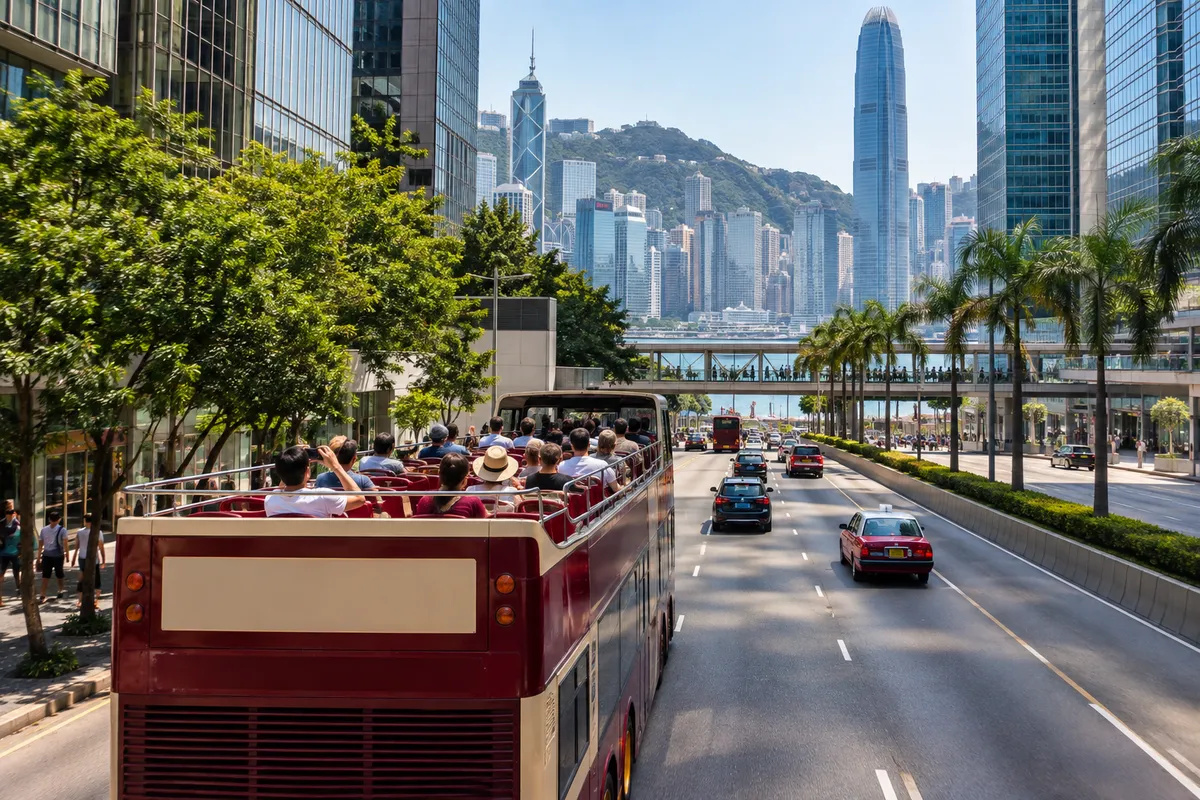
Hong Kong runs two open-top bus products that share a harbour and almost nothing else. Big Bus Tours is a private sightseeing company with three daytime loops, a night loop and recorded commentary in nine languages. HK City Sightseeing is Citybus's franchised open-top brand, sold through the same fare boxes and the same Octopus readers as the city's ordinary buses. Choosing between them is really a choice between narration and flexibility.
Both networks start from the same two points: Central Ferry Piers on the island side, and Salisbury Road beside the Avenue of Stars on the Kowloon side. Crossing between them is the part most visitors underestimate. The MTR runs under the harbour in a few minutes; a bus queues for the Cross-Harbour Tunnel, and that queue is what breaks afternoon timetables.
Two Operators, Two Business Models
Big Bus Tours Hong Kong
Big Bus runs purpose-built open-top double-deckers on three daytime circuits, Red for Hong Kong Island, Green for Stanley and Blue for Kowloon, plus a separate 60-minute night loop. Buses carry recorded commentary in nine languages and free Wi-Fi, the mobile app tracks vehicles live, and staff work the main boarding points at Central Pier 7 and the Avenue of Stars. Stops are numbered, which makes the timetable easier to follow than it first looks.
Tickets are priced in US dollars by tier. The 24-hour Discover at US$55 covers one daytime route of your choice and a one-way Star Ferry crossing; the 24-hour Essential at US$76 opens up all three routes and adds a return ferry crossing; the 48-hour Explore at US$101 adds one of three extras, either a Peak Tram return with Sky Terrace 428 admission, a harbour Water Taxi cruise or an Aberdeen sampan ride. The night loop is sold separately at US$44. Current rates sit on the operator's Hong Kong tours page.
HK City Sightseeing, run by Citybus
Citybus relaunched the old Rickshaw Sightseeing Bus as HK City Sightseeing in 2024, converting Enviro500 and Enviro500 MMC double-deckers out of its regular fleet into semi-open-top buses. Six routes carry the brand: H1 Heritage and H1S Art Discovery from Central, H2 Cultural and H2K Night Scene from Tsim Sha Tsui, and the Coastliner pair H3 and H4 linking Central with Stanley via Ocean Park, Deep Water Bay and Repulse Bay. Published headways are hourly, tightened when passenger numbers justify it. The Coastliner routes are the newest addition, added to the network in 2025 when Citybus extended the brand into the Southern District.
Route content differs more than the route numbers suggest. H1 runs from Central Piers to Tsim Sha Tsui through Exchange Square, Hollywood Road for Man Mo Temple and Tai Kwun, Lan Kwai Fong, Statue Square, Admiralty, Queen's Road East, Causeway Bay at Hysan Place, Golden Bauhinia Square and the East Tsim Sha Tsui waterfront. H2 does the reverse journey through Nathan Road, Temple Street, Langham Place, the West Kowloon Cultural District, Canton Road and the Convention Centre. H1S is a circular from Central that reaches the West Kowloon museums without crossing to Tsim Sha Tsui, which makes it the fastest open-top route if M+ is your priority.
Fares are set in Hong Kong dollars and paid on board. A single ride costs HK$47.60 on H1, H2 and H2K and HK$49.70 on the Coastliners, with half fares for children under 12 and seniors aged 65 and over. Three passes cover the network: the Open Top Bus Day Pass at HK$250 for 24 hours with priority boarding at the Central terminus, a Night Pass at HK$114 for H2K only, and the Citybus+ Dayrider at HK$198, which covers the open-top routes and adds the ordinary Citybus urban network plus the airport and Lantau services. The Dayrider is both cheaper and broader than the sightseeing-only pass, which makes the HK$250 ticket a hard sell unless you specifically want the priority queue at Central.
Big Bus quotes in US dollars and reserves the right to change prices without notice, and Citybus adjusts HK dollar fares by application. Confirm the rate on the operator's own fare page before you pay, because both networks have moved prices recently and printed figures age fast.
Boarding works differently on each system
Big Bus sells ahead of travel. You book online, add the booking to the Big Bus app, and activate the digital ticket before boarding; activation starts the 24- or 48-hour clock and the pass cannot be paused, extended or moved to a second phone. If you would rather not use the app, staff can exchange an unactivated booking for a paper ticket at the pier. Screenshots and booking confirmation emails are not valid on the bus, and nothing at the door accepts Octopus or cash.
Do not walk up to a Big Bus stop planning to tap an Octopus card. Load the ticket into the app at your hotel or collect a paper ticket from staff first; the queue of people discovering this at Pier 7 does not move quickly.
Citybus is the reverse. You step on and tap Octopus, a contactless Visa, Mastercard or UnionPay card, a transit QR code from AlipayHK or WeChat Pay, or drop the exact fare in the box. Because these are franchised vehicles, a Citybus+ pass bought for the open-top routes also works on ordinary Citybus services, and the H1 and H2 route numbers appear on the same departure displays as the commuter routes.
Big Bus Hong Kong Routes in Detail
Red Route: Hong Kong Island
The Red Route is the one to take if you have a single afternoon. Buses leave Stop #1 outside Central Ferry Pier 7 every 45 minutes between 10:00 and 17:00, and the full circuit takes about 75 minutes when the traffic behaves. The stops run through the financial district to the Mid-Levels Escalator on Queen's Road, up to Man Mo Temple on Hollywood Road, past Tai Kwun on Arbuthnot Road, along Johnston Road in Wan Chai, on to Causeway Bay SOGO and the Park Lane Hotel on Gloucester Road, and finally to the Peak Tram terminus on Garden Road before returning to the pier.
Two things about the route are not obvious from a map. The first is how vertical it feels: on Queen's Road Central you look almost straight up at the towers, and the bus passes under footbridges with barely a metre of clearance. The second is the heat. I rode the Red Route in the middle of a summer afternoon and moved to the shaded side of the deck within twenty minutes, because the seat and the floor were radiating heat and there is no shade at all on the open top. The lower deck is air-conditioned and half empty by comparison.
The Peak Tram stop is the reason many people ride this route. The Explore ticket's tram inclusion does not come with a separate queue, so the standard line at the Garden Road terminus is what you join, and it builds through the morning and on clear weekend afternoons. Riding up before 11:30 or after 16:00 is the difference between a ten-minute wait and an hour of standing.
Green Route: Stanley and the south side
The Green Route is the longest ride in the network. Buses leave Stop #9 at Central Ferry Pier 7 every 30 minutes between 10:30 and 16:30, and a full circuit takes about two hours. It passes the Peak Tram terminus on Garden Road, runs along the Wan Chai waterfront at Hung Hing Road, then crosses to the south side and reaches Stanley first, where the stop sits in the coach park behind Stanley Plaza, a few minutes' walk from the market and Murray House. Repulse Bay comes next on the way back along Repulse Bay Road, followed by Ocean Park and the sampan pier at Aberdeen.
That running order matters if you plan to hop off. Stanley is roughly an hour from Central by this route, so a market stop plus the wait for the next bus costs two and a half hours before you have seen anything on the island side. The coastal stretch between Stanley and Repulse Bay is also where the open deck earns its warning label, since the trees overhang the road and branches do brush the upper-deck railing.
Keep arms, heads and cameras inside the bus on the southern section. Overhanging branches along Repulse Bay Road and the Stanley approach have clipped more than one selfie stick, and the driver cannot see what you are holding above the rail.
Before we left Stanley the crew member walked the upper deck and told a man with a camera on a pole to bring it down. He waited until it was down before the bus moved.
Blue Route: Kowloon
The Blue Route begins and ends at Stop #16 on Salisbury Road, next to the Bruce Lee statue on the Avenue of Stars. Buses leave hourly between 10:00 and 17:00 and the loop takes about 80 minutes. From Tsim Sha Tsui it runs north to Temple Street in Yau Ma Tei, stops at the Wholesale Fruit Market on Reclamation Street, continues to Langham Place on Shanghai Street in Mong Kok, then turns back through the West Kowloon Cultural District for M+ and the Hong Kong Palace Museum before finishing at West Kowloon Station and returning to the waterfront.
Expect less on the neon front than the brochures suggest. Most of the old cantilevered signs that once canopied Nathan Road have come down under the Buildings Department's long-running signboard safety campaign, and the visual backdrop now is mostly LED facades, illuminated hoardings and shopfronts. The upper deck still gives you a wide, useful view of Kowloon's commercial density; it simply is not the film set that promotional photography implies.
The hourly headway is the route's real constraint. Step off at M+ or in Mong Kok and a missed bus costs you an hour at the kerb. From M+ the walk to Kowloon Station is about fifteen minutes and puts you on the Tung Chung and Airport Express lines; from Mong Kok, Mong Kok and Prince Edward stations are both within a few minutes on foot. Waiting for the next Blue Route bus is rarely the fastest option once you are already off it.
Night Sightseeing: Big Bus or Citybus H2K
Big Bus Panoramic Night Tour
One departure, no hopping off. The night tour leaves Stop #16 on Salisbury Road at 19:00, runs for about 60 minutes through Kowloon and returns to the same stop, with the operator asking passengers to arrive 15 minutes early. Tickets cost US$44 for adults and children alike and are sold separately from the daytime passes; they are tied to the date and time booked and are non-transferable and non-refundable. The route is a continuous loop, so boarding it as a cheap way to reach Mong Kok or Temple Street does not work, and the driver will not open the doors mid-route.
Seating decides the experience, because the open deck is the whole point. I arrived on Salisbury Road about twenty minutes before the 19:00 departure on a Saturday and still ended up on the enclosed lower deck, behind a school group that had claimed the front rows long before. If the upper deck matters to you, be at the stop by half past six.
H2K: the same waterfront for a single fare
Citybus's Night Scene loop is the value option and the one I would take. H2K runs from Central Ferry Pier 7 on a half-hourly evening schedule, first departure shortly after 17:00 and the last around 22:00, crossing the harbour through the Cross-Harbour Tunnel and looping through Wan Chai North, Jordan, the West Kowloon Cultural District, Tsim Sha Tsui and Causeway Bay. The circuit is about 22 km and takes around 85 minutes. A single ride is HK$47.60, and both the Open Top Day Pass and the HK$114 Night Pass cover it.
What you give up is narration, since the commentary sits in the HK City Sightseeing app rather than in headphone sockets, and you take on franchised-bus discipline: H2K follows a public timetable and the deck fills quickly at the Central terminus on Friday and Saturday evenings. What you gain is the right to get off. A sealed 60-minute loop and a ride you can abandon in Jordan when the view is better from the pavement are different products, and for photographs the second one wins.
Where the Two Networks Meet
Central Ferry Pier 7 anchors the island side. Red Route buses load at the kerb outside the pier concourse, Green Route buses from Stop #9 a short walk away, and the H1 and H3 Citybus departures use the bus terminus beside the same pier. Arriving by MTR, take Exit A at Central Station and follow the elevated walkway through the IFC mall; the piers are about ten minutes away and you stay under cover the whole way.
Star Ferry inclusions are exchanged here, at the operator's counter in the pier building, before you pass through the turnstiles. A weekday crossing costs HK$5 on the upper deck and takes only a few minutes, which makes the ferry a better harbour transfer than any road bus at any hour of the day.
On the Kowloon side the two systems use different addresses. Big Bus Stop #16 sits on Salisbury Road by the Bruce Lee statue, next to K11 MUSEA; Citybus open-top routes terminate inside the Tsim Sha Tsui Star Ferry bus terminus next to the Clock Tower, about 400 m west. Switching between them means a walk of roughly seven minutes along the waterfront promenade, which is pleasant after dark and considerably less so in a rainstorm.
Crossing the harbour between the island and Kowloon loops, take the Star Ferry rather than a road bus. Sailings run every six to eight minutes and the crossing never sits in a tunnel queue.
On Board: Rules, Luggage, Heat and Weather
Three rules govern every open-top ride in the city. You stay seated on the upper deck while the bus is moving; Big Bus writes that into its terms of carriage, the same requirement comes from Hong Kong's public bus regulations for franchised operators, and drivers watch the deck on camera and will stop the bus if someone stands up to photograph a building. There is nowhere to put a suitcase, because these vehicles have no external luggage bay and no lower-deck rack, so full-size cases and rigid rollaboards are refused and a daypack that fits between your knees is the practical limit. And umbrellas stay closed while the bus is moving, since a gust on the open deck turns one into a hazard for the traffic behind.
Weather can change the product without warning. Big Bus reserves the right to substitute a closed-top bus in poor conditions, and both operators suspend services when the Observatory raises Typhoon Signal 8 or a black rainstorm warning, at which point most surface transport in the city stops anyway. Big Bus posts changes on its service information page and in its app, and its terms are strict on money: refunds apply only when the operator itself fails to run the service, and night tour tickets are non-refundable once booked.
Heat is the other half of the calculation. From May to September the open deck sits in full sun for hours at a time, and the Hong Kong Observatory's UV index regularly reaches the very high band in the middle of the day, which is worth checking before you commit to a two-hour southern circuit. Sunscreen, a hat with a strap and water are not optional on the Stanley run, and the air-conditioned lower deck is the fallback when the sun wins.
What the Bus Costs Against the MTR
Set the passes against ordinary fares and the premium product looks expensive. The MTR Tourist Day Pass costs HK$75 for 24 hours of unlimited rides on the network, excluding the Airport Express and the cross-boundary stations, and you have to be able to show that you are a visitor to buy one. A normal day moving between Central, Tsim Sha Tsui and Mong Kok with a couple of tram rides and a ferry crossing lands between HK$40 and HK$65. A tram ride anywhere on the island is HK$3.30, a weekday Star Ferry crossing is HK$5, and both take Octopus.
The speed difference is what you are really paying to avoid. The MTR crosses the harbour under the water while every bus on the surface queues for the tunnel, and that trade-off is the core of my comparison of sightseeing buses and public transit.
| Metric | Big Bus Tours | HK City Sightseeing | MTR and Octopus |
|---|---|---|---|
| Adult day cost | US$55-101 (HK$430-790) | HK$250 day pass; HK$47.60 single ride | HK$75 day pass; HK$40-65 typical day |
| Headway | 30-60 minutes (Red 45, Green 30, Blue 60) | 60 minutes base, tighter in peak | 2-4 minutes |
| Harbour crossing | Star Ferry ticket included | Cross-Harbour Tunnel bus | Rail tunnel under the harbour |
| Commentary | Recorded, nine languages | App-based audio guide and on-board announcements | None |
| Traffic exposure | High | High | None |
| Best use | Orientation and photography | Cheap open-top riding | Fast point-to-point trips |
The break-even maths is worth running before you buy. A single open-top ride on the Citybus network costs HK$47.60, so the HK$250 Open Top Day Pass only starts to pay off on the sixth ride, and the HK$198 Citybus+ Dayrider on the fifth, with the airport and Lantau routes thrown in. I bought the HK$250 pass on a Saturday, rode H1 in the morning, H2 back across the harbour and H2K after dark, and came out at HK$142.80 in single fares against a HK$250 outlay. The pass was the wrong purchase, and I knew it by the second bus.
When the Bus Earns Its Price, and What to Skip
The pass pays for itself on a first visit, when the elevated view does the work of showing you how the city is put together and you are not yet confident about which MTR exit leads where. It also suits families with small children and travellers with older relatives, because Central and Admiralty stations involve long pedestrian tunnels, escalators and stairs that a bus avoids entirely, and photographers who want the angle from above the traffic. On a repeat visit with a specific list of places to see, the bus is slower than the trains in almost every case.
Two things are not worth the money. The Big Bus night tour is the first: if you only want to see the harbour and Kowloon lit up, the Citybus H2K loop covers the same waterfront and the same tunnel crossing for a single fare and lets you get off. The Stanley route on a one-day pass is the second: a two-hour circuit on a 30-minute headway can swallow most of a short trip, and the island and Kowloon loops cover more headline sights per hour.
A 24-hour plan that works
A Citybus Open Top Day Pass starts counting at first boarding rather than at midnight, which is the distinction between a calendar-day ticket and a rolling one, explained in calendar day versus rolling ticket validity. An evening start therefore carries the pass into the next afternoon. The plan below uses the HK$250 pass across the open-top routes, which is the only ticket that covers both the heritage and the coastal lines.
- 10:30, Central Ferry Pier 7: activate the pass and take H1 Heritage across the harbour to Tsim Sha Tsui, staying on the open top for the Kowloon skyline as the bus leaves the tunnel.
- Midday: walk the Avenue of Stars and the K11 MUSEA waterfront, then pick up H2 Cultural from Tsim Sha Tsui back to Central.
- Early afternoon: switch to H3 Coastliner from the Observation Wheel stop for Ocean Park, Repulse Bay and Stanley. Break the ride at Repulse Bay and take a later H3 or H4 onward.
- After dark: H2K from Central Ferry Pier 7 for the harbour lights, covered by the same pass.
- Next morning, still inside the 24 hours: an H1 loop from Central or H4 back from Stanley before the clock runs out.
48 hours with the Explore ticket
Big Bus's 48-hour Explore ticket only makes sense if you will use the bundled attraction, since the extra US$25 over the Essential buys the Peak Tram combo, the Water Taxi cruise or the sampan ride rather than more bus time. Split the days geographically. Day 1 on the Blue and Red routes for Kowloon and the island, using the included ferry crossing to link them; Day 2 entirely on the Green Route for Stanley and Repulse Bay, finishing at the Peak Tram in the late afternoon. Redeem the tram voucher at the Big Bus counter before joining the queue, and ride up with enough daylight left to see the harbour from Sky Terrace 428.